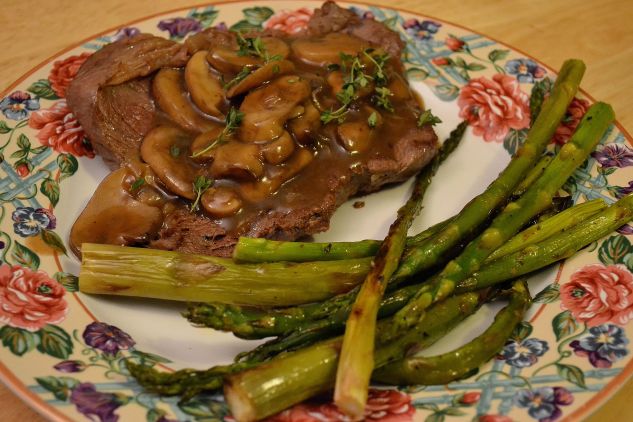
 The famous 90’s ad campaign, voiced by Hollywood icon Robert Mitchum, was an endeavor put forth by the Beef Checkoff Program to revive the name of meat. The result: Copland’s Rodeo has become a widely-recognized classical work, and beef has regained its status amongst a health-conscious America. While I’m not your standard “meat and potatoes” kind of gal, beef has certainly made a comeback in my own culinary repertoire. My initial apprehension was by no means exclusive: multiple health trends have eschewed the food group entirely, citing high levels of saturated fats and links to obesity. Yet new research encourages (moderate) incorporation of beef into a healthy diet, commending its high levels of protein and iron. I, on the other hand, can personally attest to its high level of friend-enticement: the phrase “dinner with steak tonight?” is a temptation very few friends of mine can resist. This meal was one that Mitchum would have been proud to endorse: Pan-Seared Steaks with a Port-Mushroom Sauce, and Roasted Asparagus with a Lemon Vinaigrette.
 Can I mention how intimidating it is to pan-fry a steak? Achieving that perfect balance of sear and tenderness is almost as difficult as flying in or out Hartsfield without a delay. You know the old adage “third time’s a charm?” Well, it took me three times to reach my charming steak (hence the hiatus in my blogging duties, but I can also credit that to my busy work/travel schedule). Steak is a fickle thing, and there a number of variables to consider before attempting to prepare it. My (recently created) principles for cooking steak (indoors) are as follows:
- Cast iron: if you want to achieve a taste comparable to the grill, this is your best bet.
- Resting period: allowing steak to rest at room temperature for 40 to 60 minutes is imperative to the cooking process (cold steaks will immediately smoke-up if added to a scorching hot pan); additionally, allowing steaks to rest after cooking (10 to 15 minutes, depending on the cut) is crucial to both the flavor and texture of the meat.
- Size accountability: recipes that only call for pan-seared should use thinner cuts (or be made thinner using a meat mallet) – thicker cuts should be seared on stovetop, then transferred to an oven until desired doneness is reached.
- Pan sauce: grilling is one thing, but preparing steaks indoors (pan-searing, broiling, etc) will take you much farther if a sauce is added to the pan after the steaks are done (this can be as simple as onions and butter, with salt and pepper to taste).
- Pacing yourself: don’t overcrowd a pan – if you can’t comfortably fit all the steaks at once with at least an inch of space between them, sear in 2 to 3 batches.
 The pan sauce was an amalgam of several recipes (for the sake of citation, I’ll give the most credit to CookingLight magazine). The earthy taste of mushrooms paired with the sweeter notes of Port make for one amazing steak sauce! Though originally calling for rosemary, I have always found thyme to be a more intriguing herb. The lemony intrigue of rosemary is a great pairing with root vegetables and lighter fare (chicken especially), but thyme achieves a whole new level of flavor for dishes that are heartier and more complex. For this wonderful recipe, click HERE.
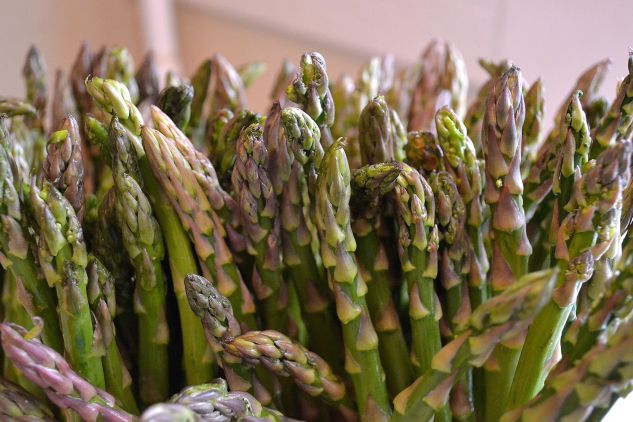 As I mentioned, I am not your typical meat eater, so the asparagus was the toast of the evening in my eyes. Roasted asparagus on its own is a great presentation, but this (extremely) simple vinaigrette made for one outstanding dish! The trick to roasting asparagus is evenly spacing the spears on one to two baking sheets, with none overlapping – this will ensure uniform roasting, making for crispy tips and tender stalks. Thyme once again finds its true colors in this dish – fresh is best, but dried can easily be substituted (I’d say 1 or 2 tsp dried, depending on how much asparagus you prepare). Check out how to make this awesome side by clicking HERE.
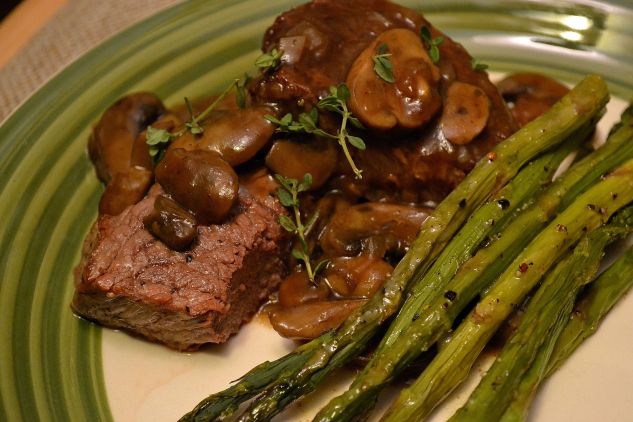 In pairing these two dishes, I had several considerations: the first (and most obvious) selection was Copland’s Rodeo – a work made famous by the original “Beef, It’s What’s for Dinner” ad campaign. Yet while waiting in Dulles for what evolved into a 3-hour delay, my coworker David recommended An American in Paris, by George Gershwin. Upon further consideration, I realized this was the a truly accurate context for the meal. Steak is certainly a dish that many American households enjoy, yet the preparation (pan-seared instead of grilled) and sauce (shallots and port wine) find stronger relevance within the French traditions. Additionally, the roasted asparagus is dressed in vinaigrette – a dressing derived from the French term vinaigre that is often interpreted as “French dressing.”* Voilà! But let’s talk about the music: this piece, composed in 1928, hopes to captures the spirit of Paris, replete with colorful personalities and breathtaking sights. Gershwin was inspired to write An American in Paris after having spent a short period of time there himself. The work gained its greatest renown nearly 25 years later through the 1951 film adaptation starring Gene Kelly and Leslie Caron.** The video I’ve included here is from the film – it is an excerpt from the dancing duet of Kelly and Caron, dancing through a fountain in Paris to a sultry trumpet solo (by the MGM legend Uan Ransey). For those wanting more than this musical apéritif, feel free to watch the second selection: the New York Philharmonic’s historic performance in North Korea (An American in Pyongyang?) This video is in three parts, and actually transitions into the next piece of the concert in Part 3. This is a must hear work, making the film a must-see as well. Hope you enjoy, and bon appétit!
1) http://www.youtube.com/watch?v=wlvzGT1Ta2w
2) http://www.youtube.com/watch?v=BUfI6v6SwL4&feature=related
Sources Cited:
*“Vinaigrette.” Wikipedia.com
**“An American in Paris” Wikipedia.com

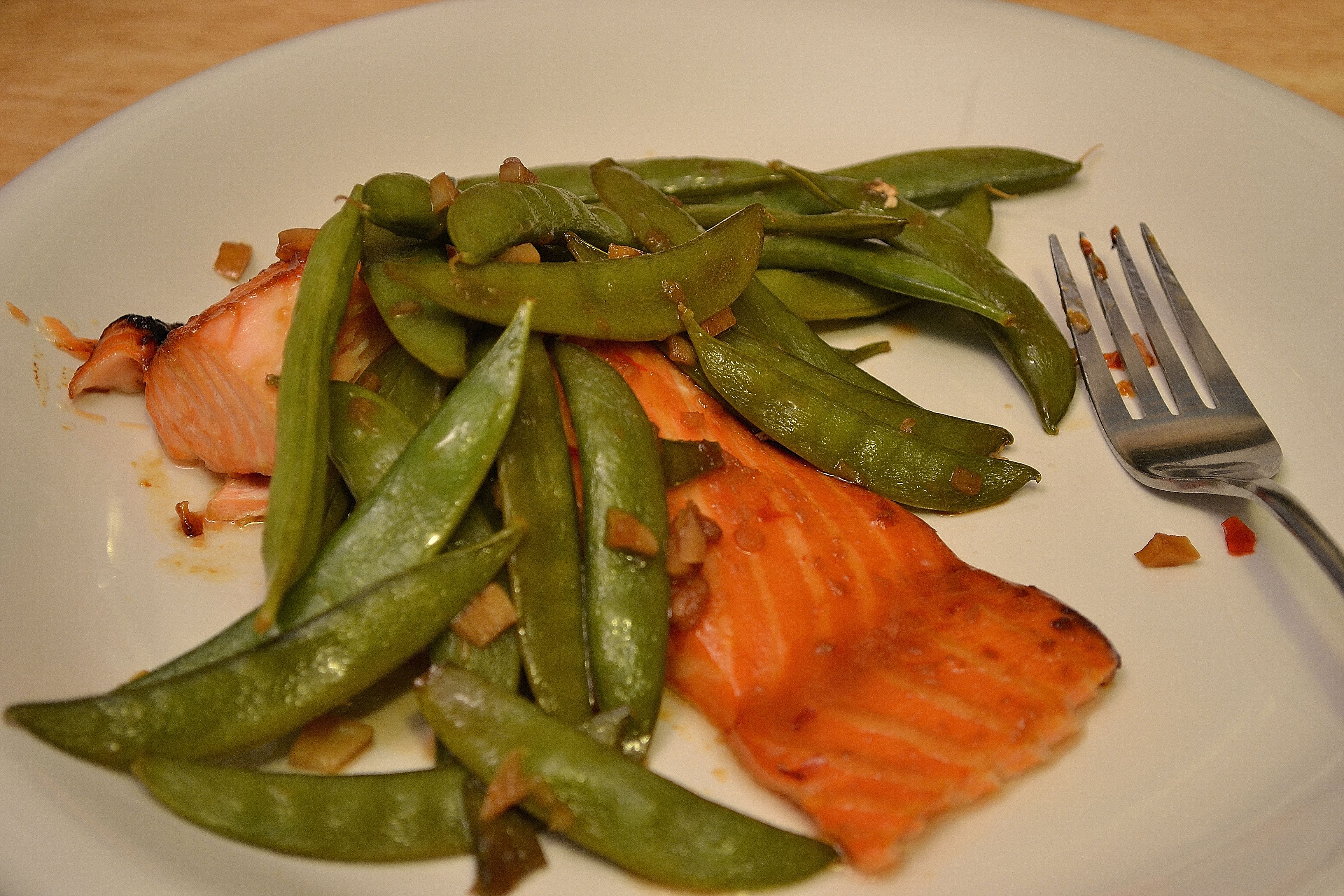 Alaska’s wild salmon fisheries are considered to be among the best-managed stocks in the world due to extensive monitoring and safer catching methods. The result is a fish that provides the best flavor and greatest nutritional gain of all supermarket varieties.* I wanted a simple recipe so as not to mask the excellent quality of this fish. Perusing through my stacks of cooking magazines, the cover of a Bon Appétit issue caught my eye – absolutely gorgeous! I roughly adapted the original to serve 2 (instead of 6). I removed the skins, marinated the fish for a longer period of time, and omitted the pea sprouts originally called for by doubling the amount of sugar snap peas. Make this dish – I promise you won’t regret it. Click HERE to view my version of this recipe.
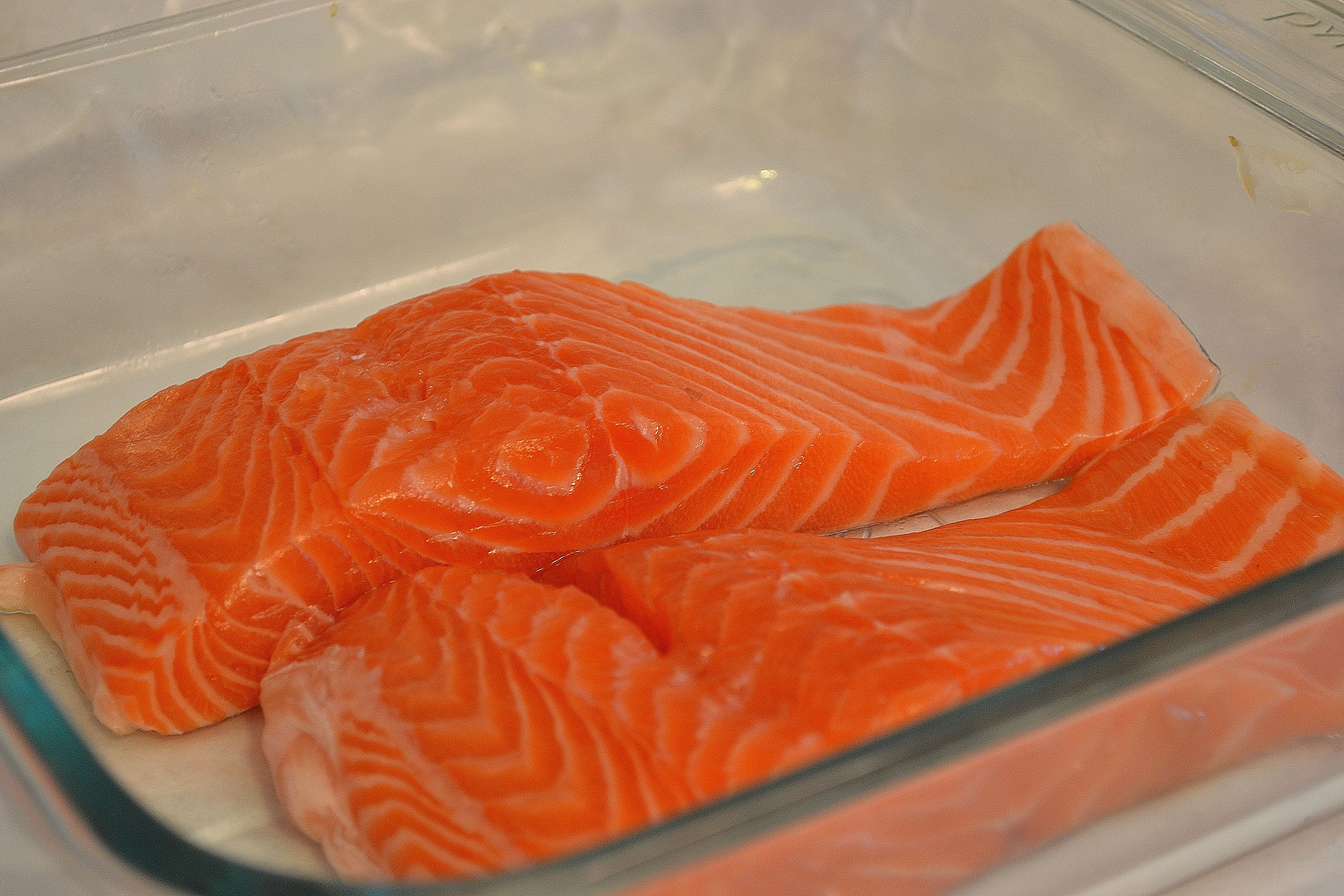 The migratory lifestyles of salmon make them quite a remarkable species. They are born in freshwater, then spend the majority of their adult lives in oceans, and finally return to their natal streams and rivers for spawning. Given the simplicity of the recipe, I chose to focus on this concept, returning to where one begins, and thus pair this dish with Prokofiev’s Symphony No. 1 in D major, “Classical Symphony”. Composed in 1917, this work is identified as a neoclassical composition, in other words a work influenced by the aesthetic principles of “classicism”. This particular work loosely emulates the style of Haydn, a composer who Prokofiev studied extensively while attending the St. Petersburg Conservatory; a “return to his (classical) roots,” if you will.** I also just really like this piece, and have been wanting to showcase it here for quite some time. I’ve included a recording of Claudio Abbado (the orchestra is unlisted, unfortunately) conducting the work’s first two movements: Allegro and Larghetto. There is a part 2 which can be found in related videos for the remaining two movements. I also had to include the fourth movement as interpreted by Valery Gerviev and the Vienna Philharmonic – this is what Prokofiev sounds like on steroids, and is a tempo that is nearly impossible to execute without injury…enjoy!




 THE CLASSICAL KITCHEN