Easter’s Cutest Traditions

When you travel as much as I do, you tend to lose track of the various holidays. Fortunately, we’re often bombarded with constant reminders whenever making the weekly CVS/supermarket run (whose shelves are lined with seasonal frippery months in advance). When Easter rolled around, I had a different reminder: my roommate Jenn had decided to give her Artist Diploma recital on Good Friday. She asked me to bring some form of dessert, and it was all too easy to give in to Easter’s colorful traditions with these Mint-Chocolate Birds’ Nests.
I never imagined I would be placing a package of crunchy chow mein noodles into the same camera shot as a bag of Cadbury chocolate eggs…yet here they were – two food products whose chance pairing make an adorable, crunchy delight. The only time I’d ever used chow mein noodles had been as topping for a chicken stir-fry…a far fetch from chocolate. Though labeled as “noodles”, they are actually cracker-like in both taste and consistency. This otherwise bland flavor makes them an easy complement for a variety of dishes.
These are extremely simple to make, and can be assembled in a matter of minutes. The first time I made them was with butterscotch and peanut butter. Looking for a new flavor profile, I added a dash of peppermint extract…and oh my God they were good! The perfect combination of crunch and sweet, these are a quick and easy way to entertain and delight your friends – click HERE to see how to make these adorable treats.
Considering I made these for my roommate’s recital (which was a phenomenal concert!) it was only fitting that the musical pairing be a piece she performed. Her program began with two Good Friday arias, and I chose the first of these for my pairing: “Endlich wird mein Joch” from Cantata BWV 56.  Bach composed this cantata in October of 1726 during his time as Cantor at the St. Thomas Church in Leipzig. “Endlich” is one of the more uplifting arias from this otherwise somber cantata, celebrating the “end of suffering”. The translation is as follows:

Finally, finally my yoke
Must again be lifted from me.
Then I shall battle in the Lord’s power,
Then I shall be like an eagle,
Then I shall ascend from this earth,
And soar inexhaustible.
Oh, may it happen yet today!

The joyous tone of the piece perfectly complements these delicious treats, with the lyric “like an eagle” serving as the obligatory literal piece 🙂 She performed the piece with my very dear friend Tim Wilfong singing the baritone line (who did a fabulous job!) The recording below is with oboist Marc Lifschey (one of THE American oboists, according to Jenn) and baritone Mack Harrell. Enjoy!

http://www.youtube.com/watch?v=C_589br3HP8

Sources Cited:
“Cantata #56 ‘Ich will den Kreuzstab gerne tragen'”, Bellingham Festival of Music
“Helmut Rilling interprets Bach Cantatas,” www.drmm.net
A Colorful Start to Spring

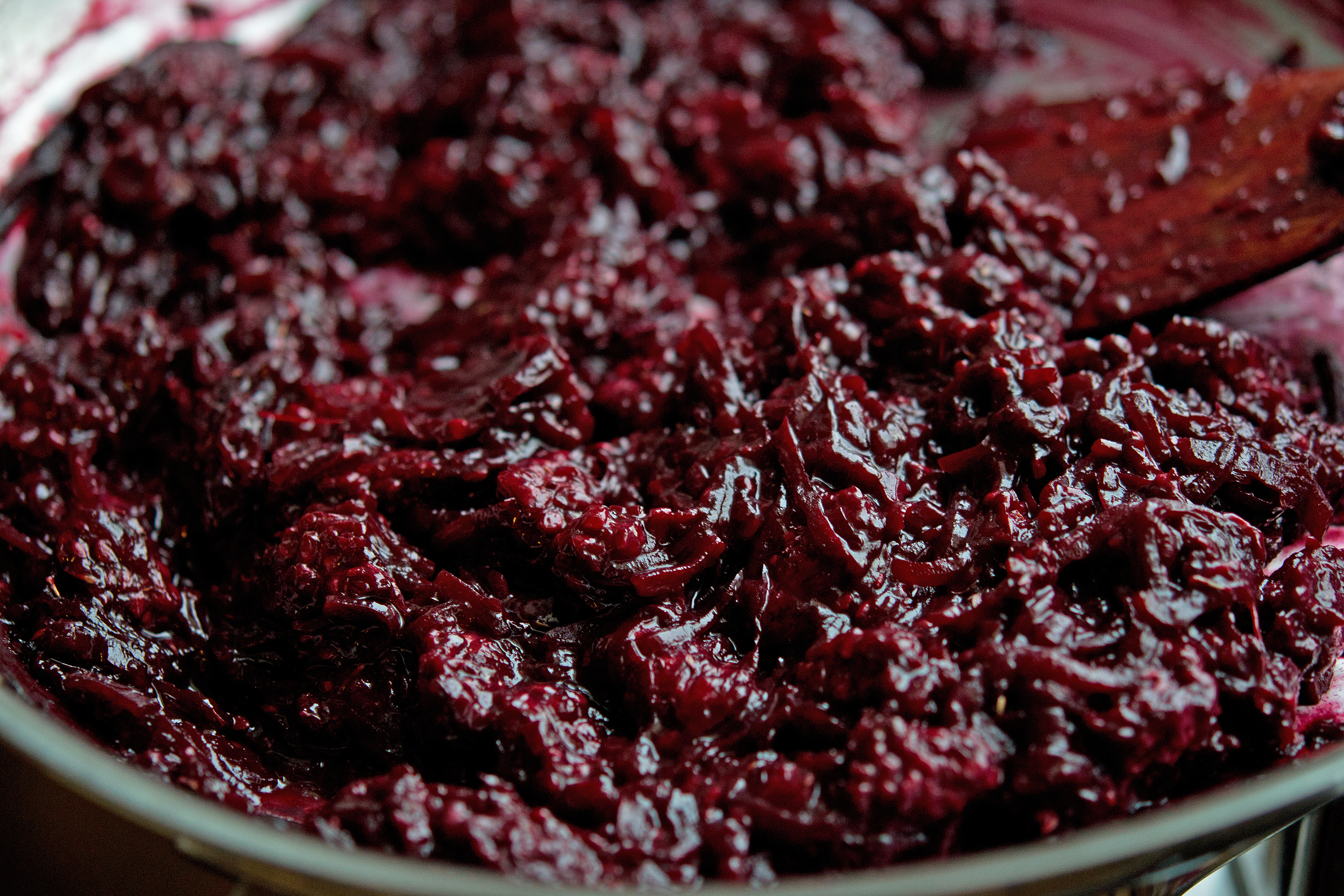
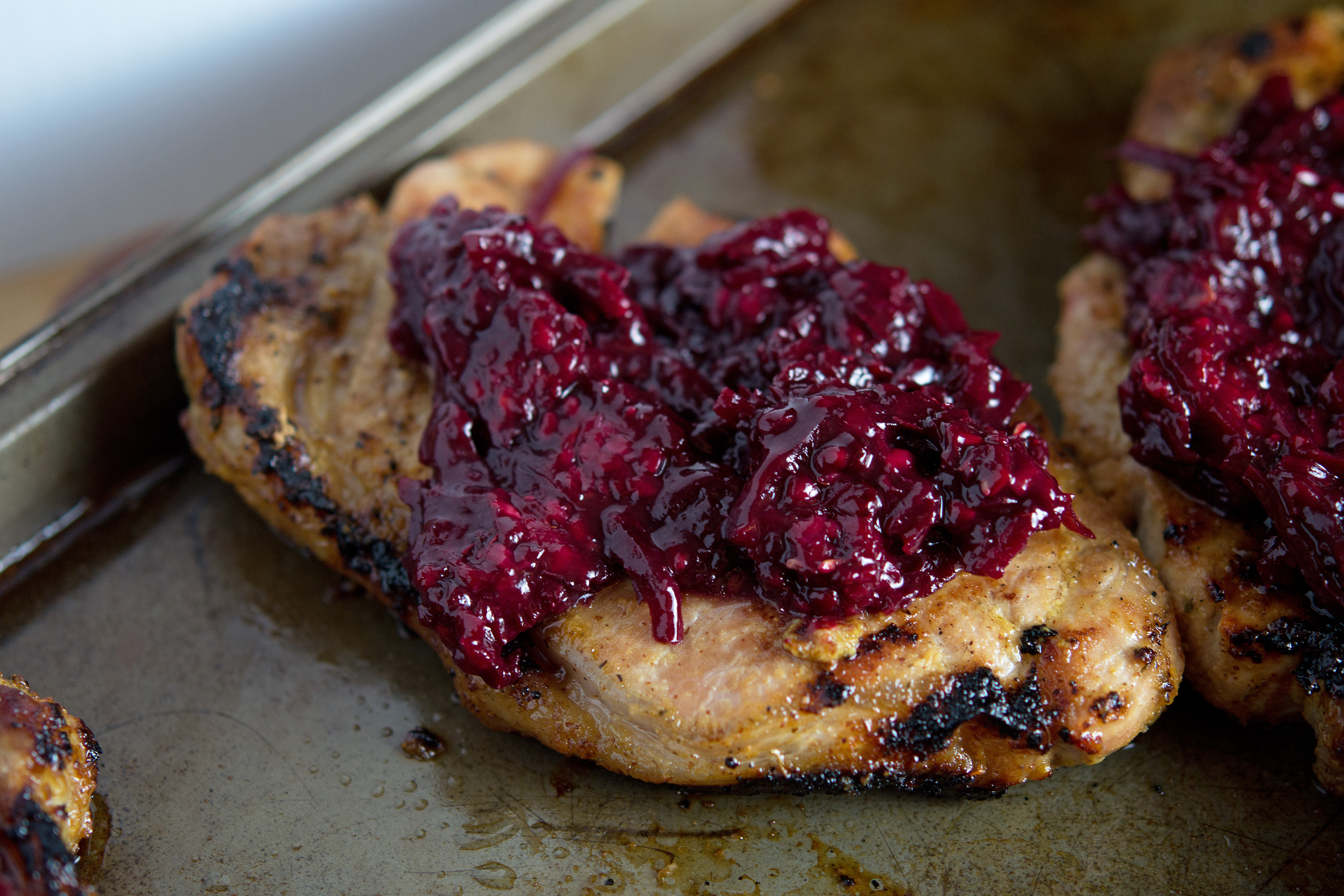
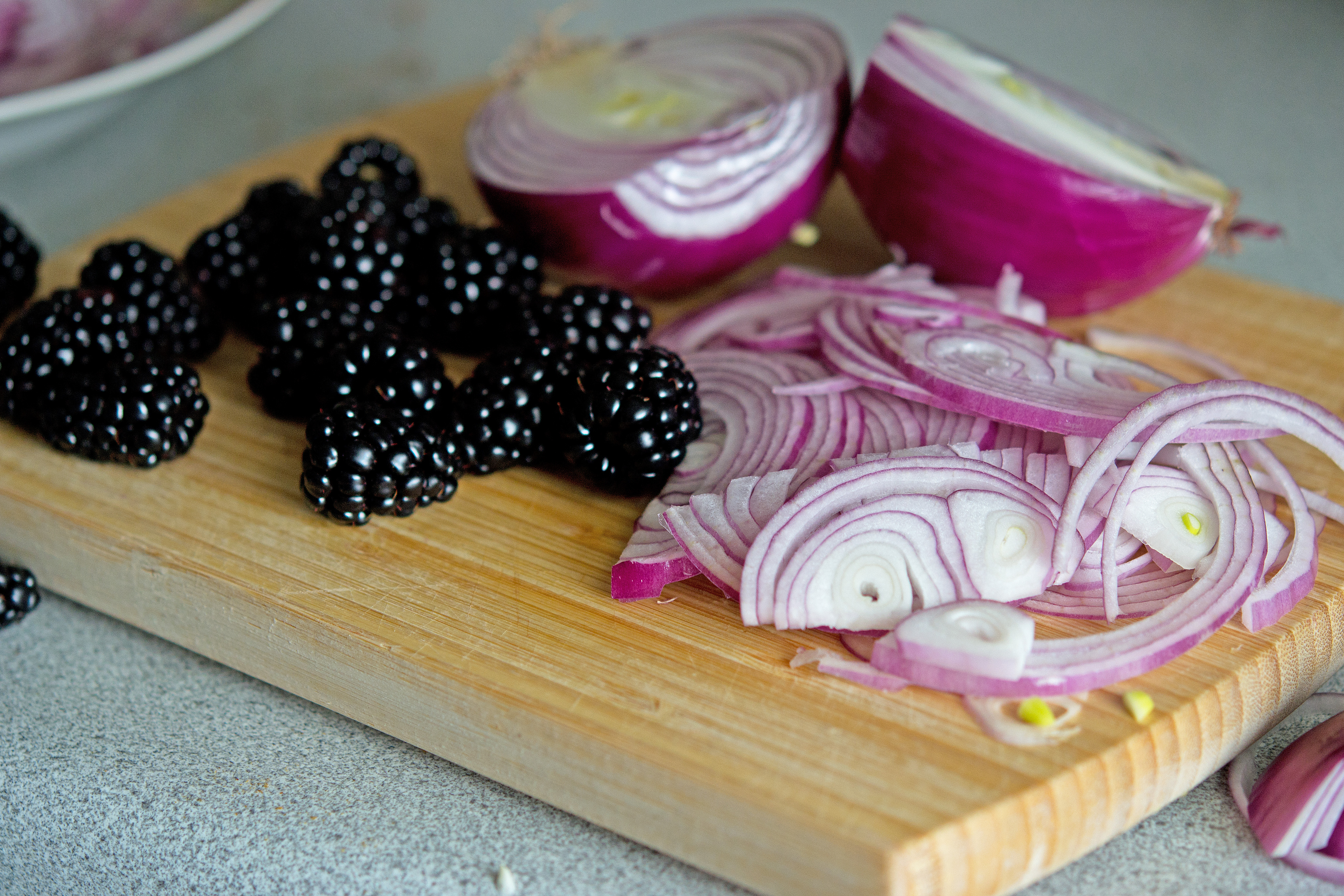
Even though we never had an authentic New England winter, no human being ever wants to endure 20 degree-weather. So now that we’re seeing the hopeful edges of spring, I wanted to whip out the grill and give it a go….yet I wasn’t really sure what it was I should actually grill. Since no inspiration was coming to mind, I made the random choice to choose a meat that was deserving more attention in my recipe archive – pork. After ruling out whole tenderloins and deciding bone-in wasn’t worth the added hassle, I made some amazing Grilled Pork chops with Blackberry-Onion Compote.
I might have lost a few of you with the compote, but bear with me – even though it looks like something out of a Muppets movie, it is an awesome complement to the dish. Fruit and pork have always been a good match, and the blackberries at the market were practically bursting – needless to say, I couldn’t resist. The result was amazing, with leftovers being scooped onto slices of bread and cheese. It can be paired with any grilled meat, and makes for a really unique spread regardless. Click HERE to learn how to make this beautiful combination.
Whenever I think of pork, I always think brussels sprouts – perhaps it’s due to the extreme aversion I held for both as a kid. Thank God I grew out of that, especially brussels sprouts. While these turned out to be quite spectacular, the recipe can be a little tricky – you are going to think that you’re burning the sprouts, when in fact the most beautifully browned crust is created. Timing is key, or else they will, well, burn. These Pan-Browned Brussels Sprouts will sink any doubts you’ve ever had about the vegetable, trust me – click HERE to see the recipe.
As my first “spring” posting, I wanted the musical pairing to be a piece acknowledging the season. I have yet to pair Vivaldi’s “Spring” on this blog, yet it wasn’t quite on par with the complexities of this particular dish. No, this was a pairing for Beethoven, and what luck that he his Violin Sonata No. 5 is also known as the “Spring” sonata! The four movements paint a vibrant illustration of the season, vacillating between moments of festive joy to gentle empathy. With such a colorful array of character and music, it was practically the perfect pairing (aside from the literal connection) for this dish. The recording below is with Igor Gubberman on violin – enjoy!

http://www.youtube.com/watch?v=cxL8tAByp2U

A “Fiery” Evening

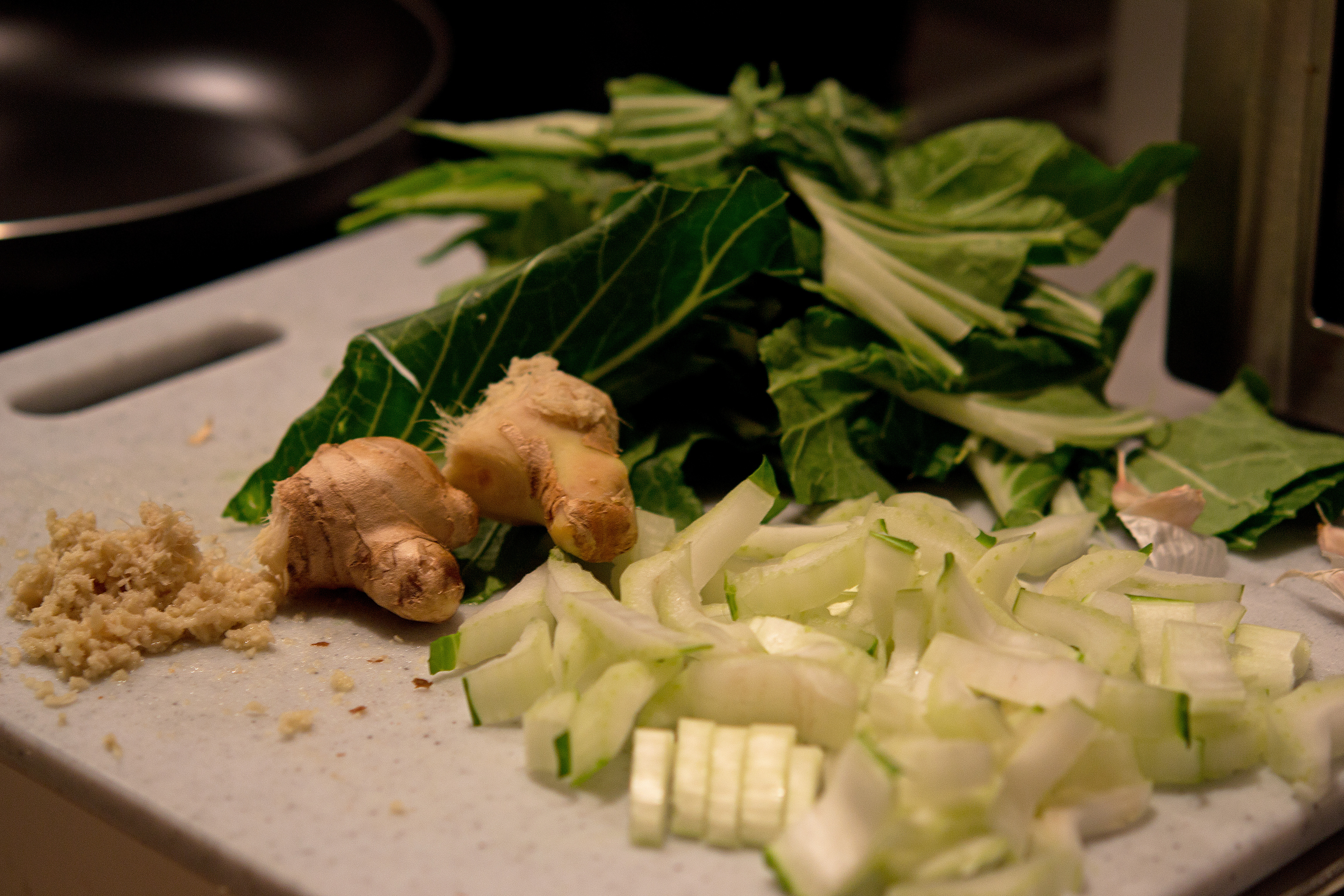
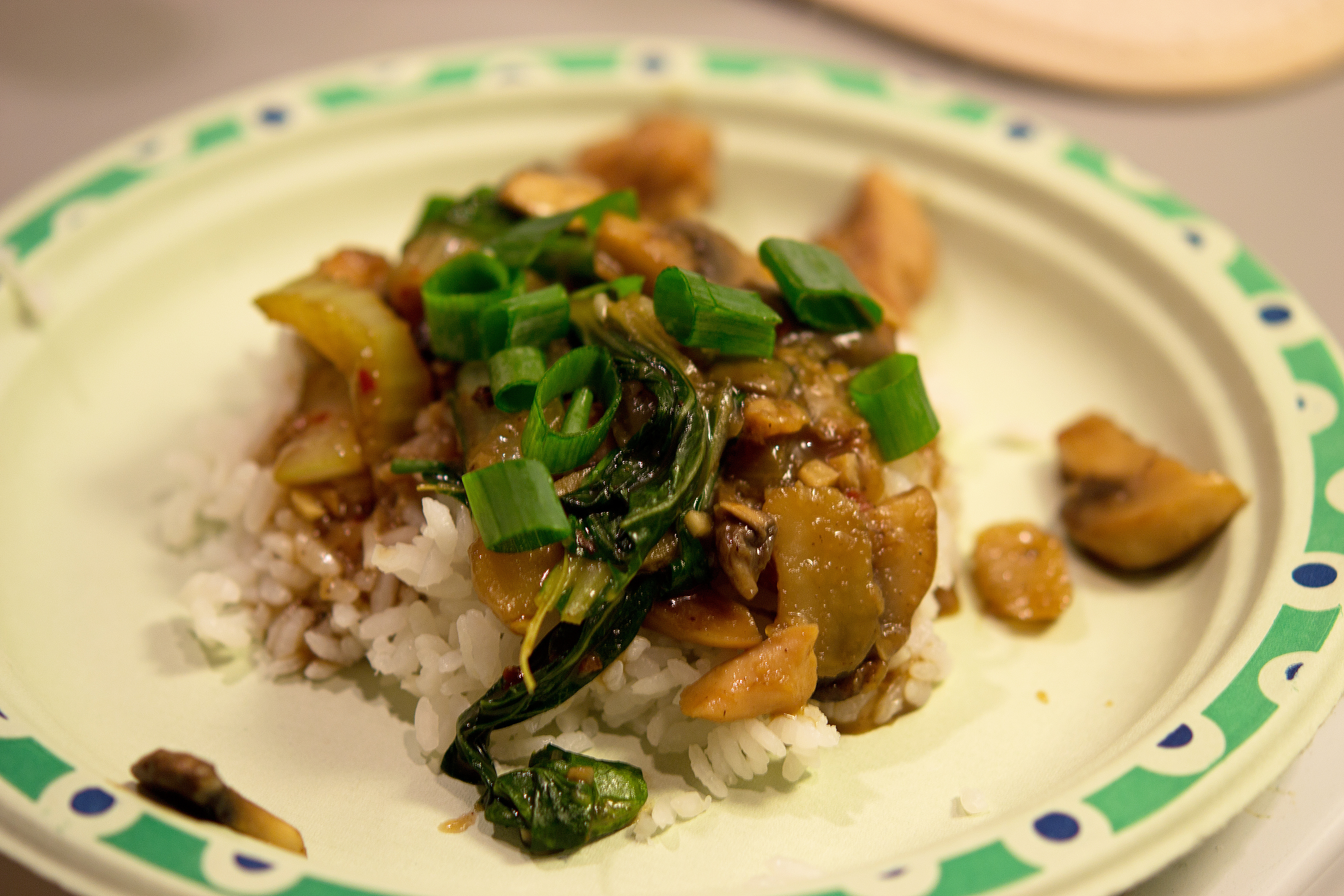
I was walking with my friend TJ over to his place to make dinner the other day, when we both saw it: a towering cloud of black smoke billowing into the sky (see photo at the end of this post). We walked closer towards Boylston Street and realized said cloud was the coming from the Prudential Center…we later learned that an 115,000-volt transformer had caught on fire at the adjacent HIlton Hotel. With the cacophony of sirens and a dark, smoky sky just outside our window, we prepared a spicy Asian meal that was all too fitting for the “fiery” event we had just witnessed: Spicy Chicken Chop Suey and Sesame Green Beans.
Chop suey is believed to have originated in Taishan (a coastal city in the souther Guangdong province), and was introduced to the United States by Chinese immigrants during the early 19th-century. It’s literal translation means “assorted pieces.” The traditional preparation includes a meat with chopped vegetables and aromatics, which are all cooked in a starch-thickened sauce and served over rice or noodles.
This dish was a definite winner – though the ingredient list seems substantial, most are pantry items you will have on-hand for the repeats you will guaranteed be making of this dish. Wanting a spicy kick, I decided gave it an extra dose of pepper flakes. Feel free to substitute any meat for the chicken, and any other vegetables for that matter (carrots and sugar snap peas would be excellent!) It can ultimately be an “assortment”  to your liking – click HERE to see how to make this spicy dish. For the side, I just blanched the green beans, then pan-seared the heck out of them in a bit of olive before tossing in some cloves of garlic, sesame oil, (lots of) red pepper flakes, salt and pepper. Delicious!
Unable to shake the “fire” theme, my musical pairing for this meal is Manuel de Falla’s “Danza ritual del fuego,” from El Amor Bruj0 (Love, the Magician) – 35 minutes in length, this Gitanería (gypsy ballet) was originally scored for an “assortment” of performers: cantaora voice, actors, ballet dancers, and chamber orchestra. It was adapted the following year for orchestra and mezzo-soprano. In the work, our heroine Candela is desperate to drive away the ghost of her dead lover, and appeals to the fire-god in hopes of vanishing his haunting spirit. The “Danza ritual del fuego” marks her attempt to do so, in which she seduces her lover and pushes his spirit into the flames. The work has a bohemian flair, yet maintains de Falla’s Spanish touch. The recording below is with the Chicago Symphony and Daniel Barenboim, enjoy!

http://www.youtube.com/watch?v=auRUxPPqDcQ

Sources Cited:
“Chop Suey,” Wikipedia.com
“Ritual Fire Dance (Falla)” Wikipedia.com

(taken on my phone while walking with TJ)

Short and Sweet

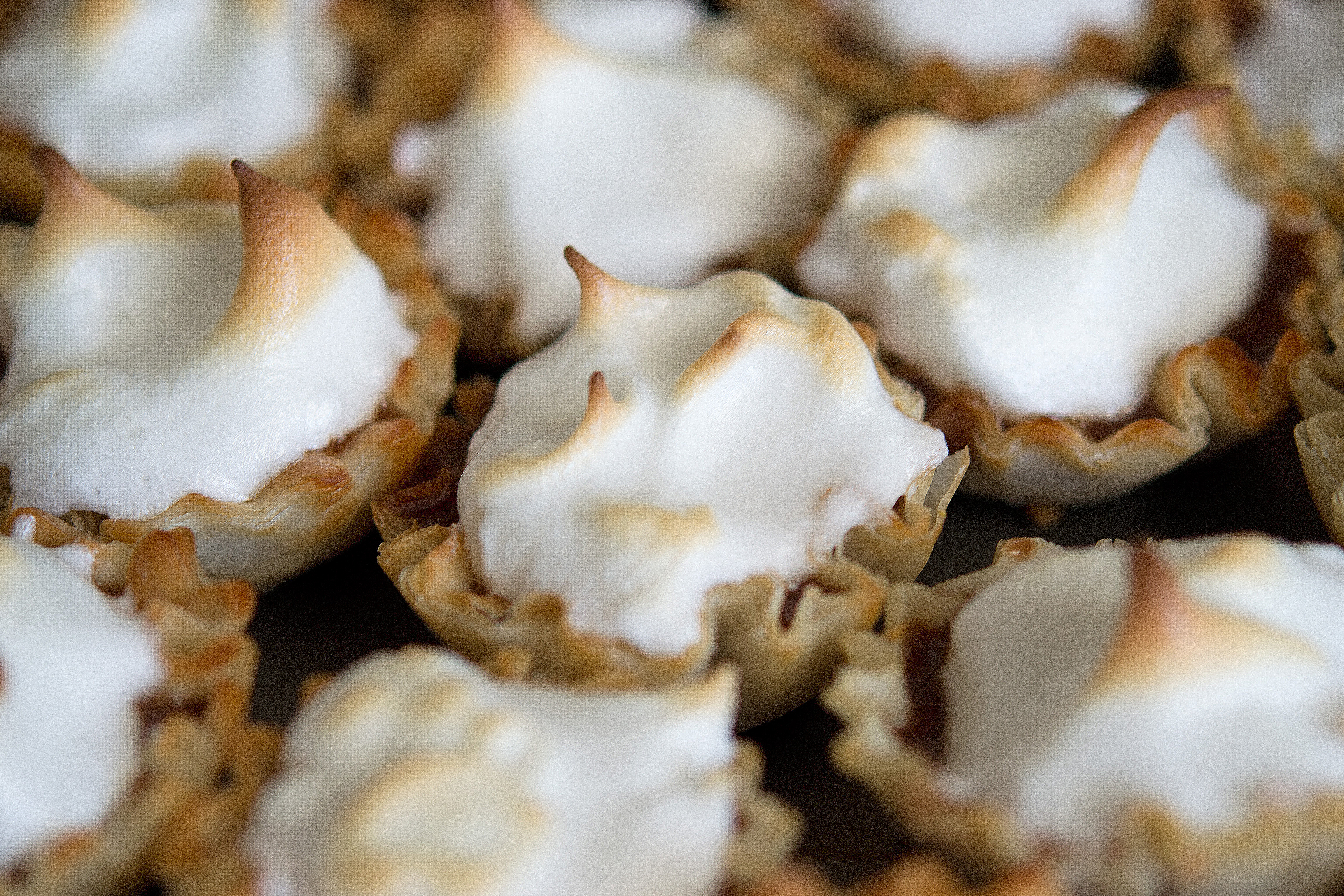
There is no lack of desserts when I host an event – tell me 20 people will show, and I’ll make enough for 50. My Oscars Party was no exception. It also gave my creative edge a challenge – as you read in my last post, each dish was paired with a nominated film. Some of the  pairings were a bit of a stretch (cocktail wieners with Hugo?), though it was fun to do nonetheless! These were definitely two of the stars from the evening’s spread (as were the films with which they were paired): Mini Chocolate Pies and Black & White Cookies.
For those of you who read the book/saw the movie, it’s no mystery that I paired these Mini Chocolate Pies with The Help (definitely worth seeing if only to understand why this is the case, though it is a great movie). They’re quite simple to make – I purchased several packages of phyllo mini tarts, made a simple chocolate pudding to fill them with and topped each with a dollop of meringue. Your guests will think you put in WAY more effort. Click HERE to see how to make these adorable bite-sized treats.
Black & White cookies are classic, and I had always been curious to give them a try. They were paired with The Artist (a literal pairing, granted) which was hands downs my FAVORITE movie of the year – I practically leapt from my seat every time it won an Oscar. These are more cake-like than your average cookies (thanks to the use of cake flour), and are topped with a thick, glossy icing that takes seconds to make. They were a huge hit at the party, and I imagine they’ll be adored at your next event as well – click HERE to see how to make these sweet classics.
I wanted the musical pairing for these two desserts to acknowledge their “bite-sized” enjoyability – both also compelled my more creative edge. That led me to consider fulfilling works that can also be defined as “short and sweet”; musical novellas if you will. With this in mind what better pairing than Schumann’s Fantasiestücke, Op. 12! Inspired by a collection of novellas by E.T.A Hoffman, the eight pieces within the work capture different the moods and thoughts of Schumann’s dual identities, known as the characters “Florestan” and “Eusebius.” Seeing how both of these desserts brought out my more creative edge, I felt the dreamer in Eusebius would be the best fit and thus chose the first of the eight pieces: “Des Abends” in D-flat major. It’s gentle melody lulls the listener into an ephemeral state of serenity; refuge from the noise and chaos of reality (a similar experience to be had after trying one of the delicious treats in this post). Enjoy! 

http://www.youtube.com/watch?v=VNcavAwICR8

Sources Cited:
“Fantasiestücke,” Wikipedia.com

A Star-Worthy Spread

The Academy Awards: an evening of glamor where the “who’s who” of Hollywood gather to honor the year’s most celebrated films. For a hostess, it is the perfect excuse to throw a party – but this couldn’t be just any part, it had to be in true Hollywood form: red carpet entrance, formal attire, and of course classy hors d’oeuvres.  For this post, I though I would share three of the dishes featured in the extensive spread: Coconut-Crusted Chicken Tenders, “Eggstremely Good” Deviled Eggs, and Fiery Jalapeño-Bacon Bites.
It’s worth mentioning that I created appetizers to pair with each of the various film nominees. These chicken tenders, for example, were grouped with The Descendants: a film starring George Clooney that takes place in Hawaii. Though simple in concept, the flavor of these was extraordinary (and a wonderful twist on the standard breaded variety). They can be served with any dipping sauce, though sweet chili sauce works quite beautifully – click HERE to see how to make these tasty chicken tenders! 
I think deviled eggs have received a bad rep as the appetizers found at any and every gathering, devoid of flavor and character. In reality, they provide the perfect canvas for creativity: wasabi, curry, even smoked salmon are all flavors to try! On top of that, they are great for large parties (budget-friendly!) and such an elegant addition to any affair. I paired these with the film Extremely Loud and Incredibly Close (as their title suggests).
While deviled eggs are a classic, a solid foundation is vital to their success which, of course, starts with boiling. Too often are we plagued by hard-boiled eggs with gray, chalky yolks. Yet there is a trick to guarantee a perfectly cooked center every time – removing the eggs from the heat once the water reaches a boil. I was apprehensive of this method at first glance, though it is utterly foolproof. Click HERE to see the recipe for these “eggstremely good” bites!
These aren’t just spicy…they are downright addictive. Who would have thought the simple trio of jalapeño, cream cheese and bacon could have so much moxie? Warning: you will NOT want to stop eating these once you’ve started…a fate many of my guests fell victim to. I paired these with the film Girl with a Dragon Tattoo given their dangerous, “fiery” appeal. I guarantee these WILL be the star at your next event – click HERE to see how to make these addictive bites.
Movies are an addictive diversion: the excitement, the passion, the humor – it compels us to buy tickets or press play time and time again. With that in mind, I wanted a piece that truly captured the energy of the “movie magic”; a piece that pulls you in, and has a palpable, compelling story. Funnily enough, I was only recently introduced to this work, yet it is the ideal match: Poulenc’s Sonata for Violin and Piano. Composed during the German occupation of Paris, the piece is replete with passionate energy. It is dedicated to Federico García Lorca – a Spanish poet assassinated during the Spanish Civil War. The first and third movements are driven by a dark, potent energy that bring listeners to the edge of their seats, while the second evokes a deeper emotion for which we have no words (though Lorca does, with Poulenc attaching the following quote by the poet to said movement: “The guitar makes dreams weep”). The following recording is with violinist Josef Suk – enjoy!

http://www.youtube.com/watch?v=o41e7qcSwSw

Sources Cited:
Program Notes – WPAS: Itzhak Perlman, violin and Rohan DeSilva, piano,” Strathmore.org

A Dish to Your Liking

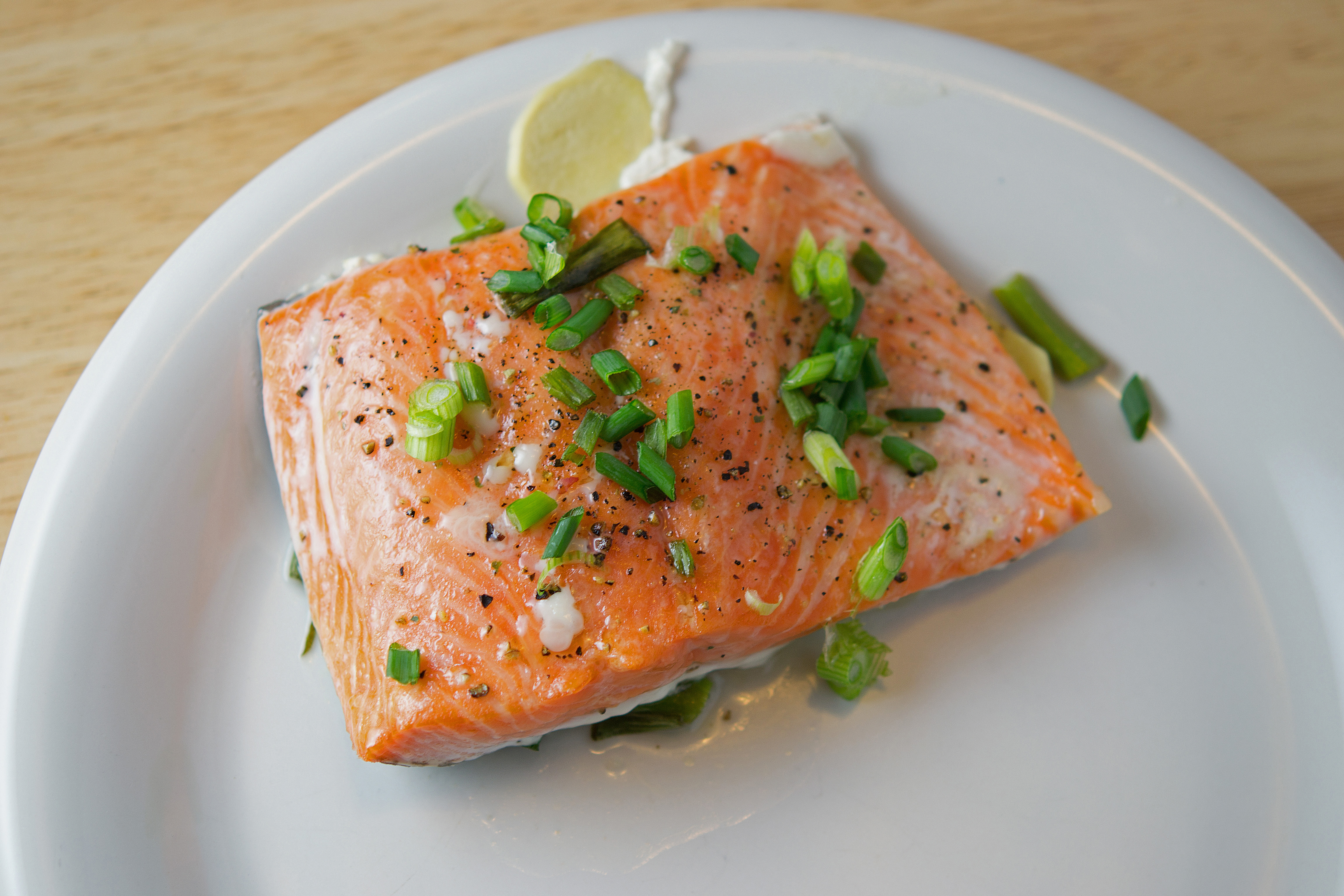
Salmon: an established icon in the realm of health foods, that has yet to lose momentum. A single 4-oz serving boasts skyrocketing levels of vitamins D and B12, in addition to being a excellent source of protein and omega-3 fatty acids. The problem? Overcooking – the luscious, tender filets we often enjoy in our favorite dining establishments often translate into a dry, chalky entree in our homemade attempts. Sure, you can dredge it in a glaze or sauce, but then why bother spending so much on salmon in the first place? That’s why this method will change your life – trust me, you’ll never look back once you’ve tried Slow Cooked Salmon.
I found this recipe on one of my favorites, Steamy Kitchen – it has an AMAZING result, with little to no effort. It’s just a matter of setting the fish on a bed of aromatics, and popping it in the oven for 30 minutes or so. What you get is to-die-for texture that doesn’t take away from the integrity of the fish. Her recipes provides a number of flavor variations as well. Craving ginger, I went for that one (plus I have a huge crush on green onions – they tend to make most things taste amazing). I added a splash of white wine midway through cooking, and a squeeze of lemon at the end to spruce things up a bit – click HERE to see this foolproof method for cooking salmon.
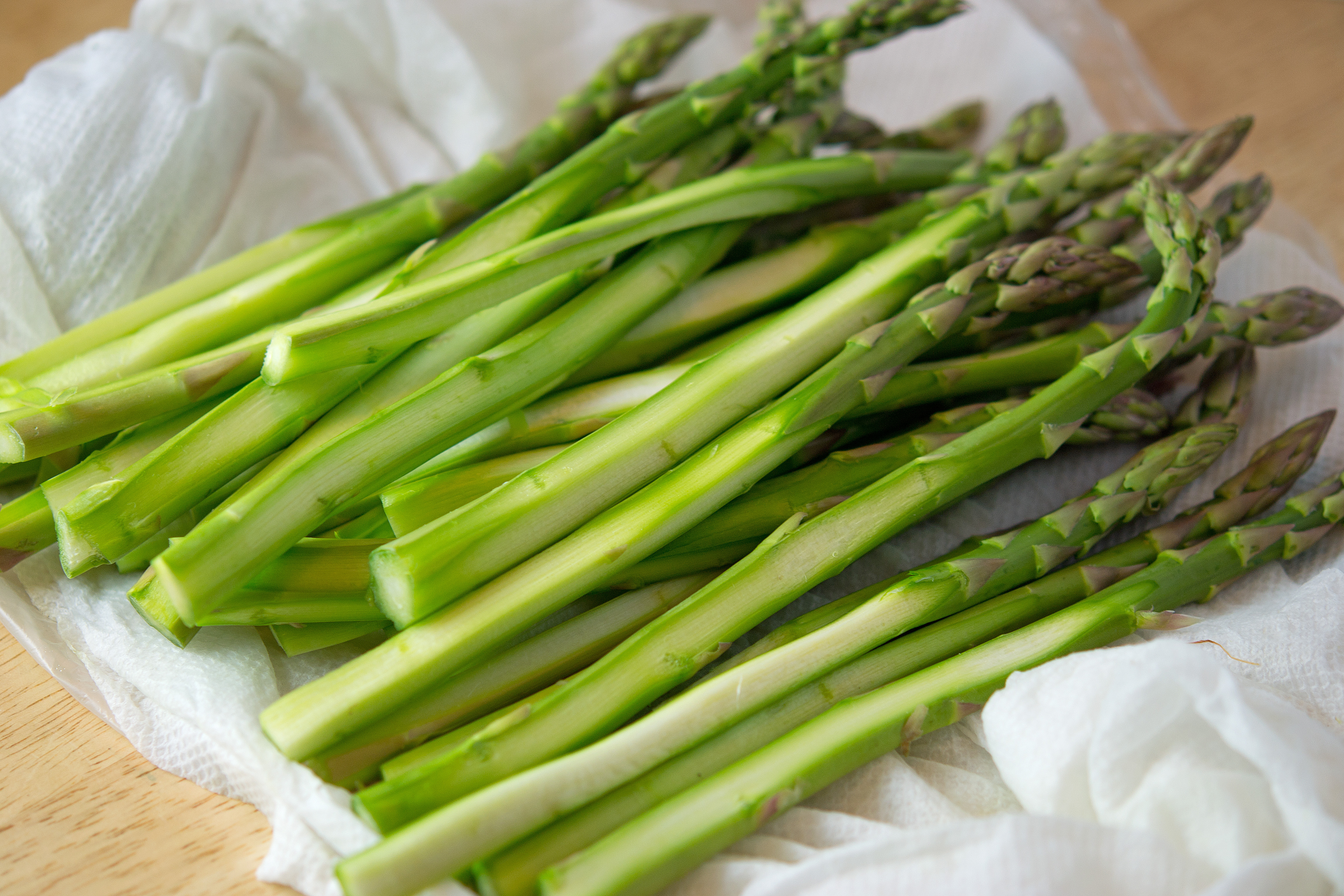
There is something all to fitting about asparagus and salmon, and went with Sesame Asparagus. I was looking for thin asparagus at the store (for sauteeing), yet could only find tree-like stalks. My first thought was to fold and buy spinach instead, but I then remembered Julia Child’s method of peeling the stalks. She claims the result is a fresher, greener asparagus that takes much less time to cook. So I decided to go for broke and bought the thicker stalks – Julia, as always, was spot-on. It cooked in MUCH less time, retaining its colorful hue and tender crunch. On top of that, the sesame-soy sauce was fabulous! Click HERE to see how to make this lovely side dish.
For the musical pairing, I wanted to draw my attention back to the salmon – the whole concept behind the recipe is to maintain the integrity of the original fish, yet leave room for creativity. That led me to Eugène Bozza’s Image for solo flute. Written in 1939, it is dedicated to flute pedagogue extraordinaire Marcel Moyse. Much like this salmon recipe, the work is very open to interpretation, inviting the performer to approach it with “the character of an improvisation.” The piece alternates from inquisitive to jubilant, weaving cadenzas with lilting scherzos that showcase both technique and sonority. The recording I’ve included is with flutist Alexandra Grot – enjoy!

http://www.youtube.com/watch?v=alzS8hPsOfI

Sources Cited:
“Salmon,” World’s Healthiest Foods

Simple yet Stunning

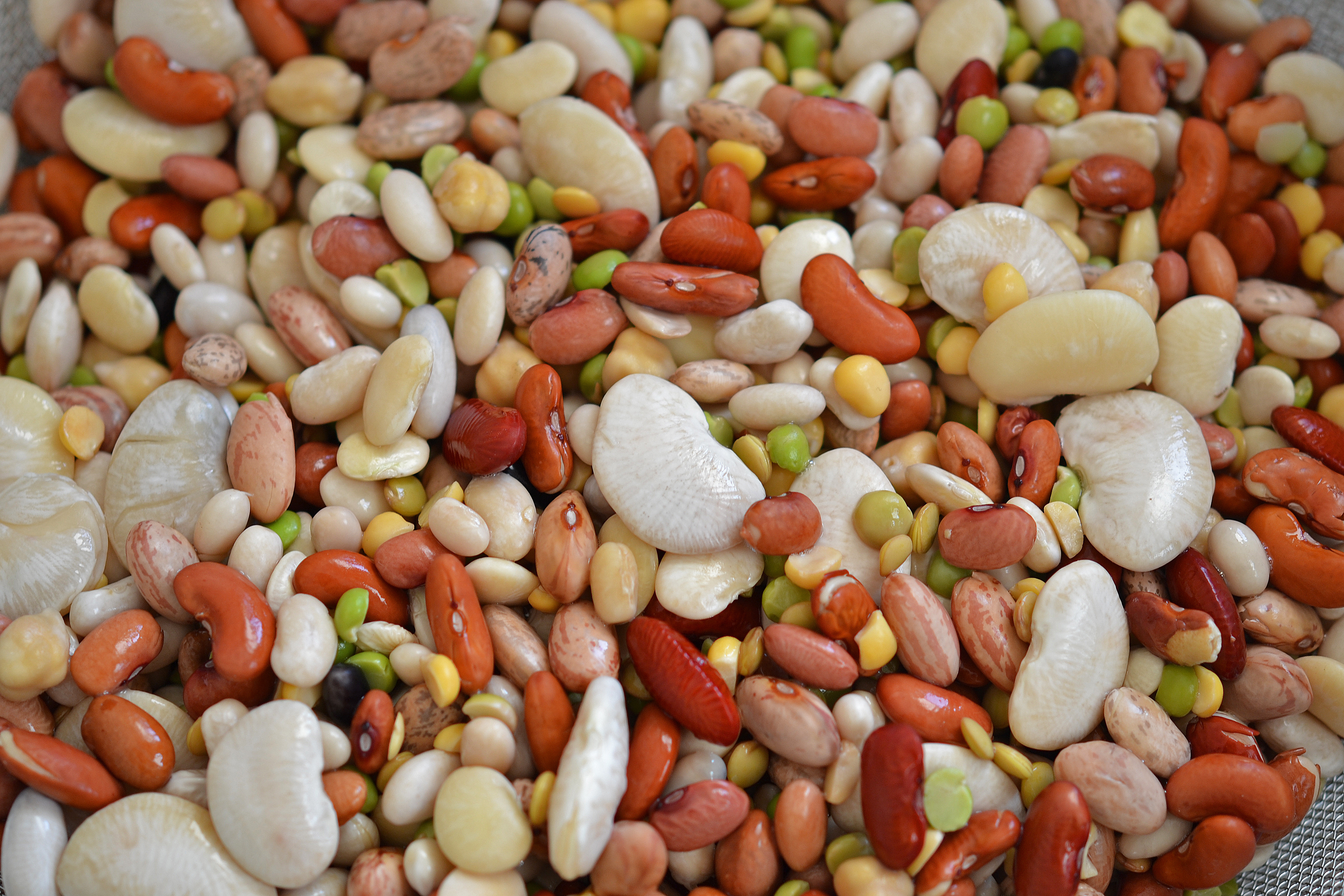
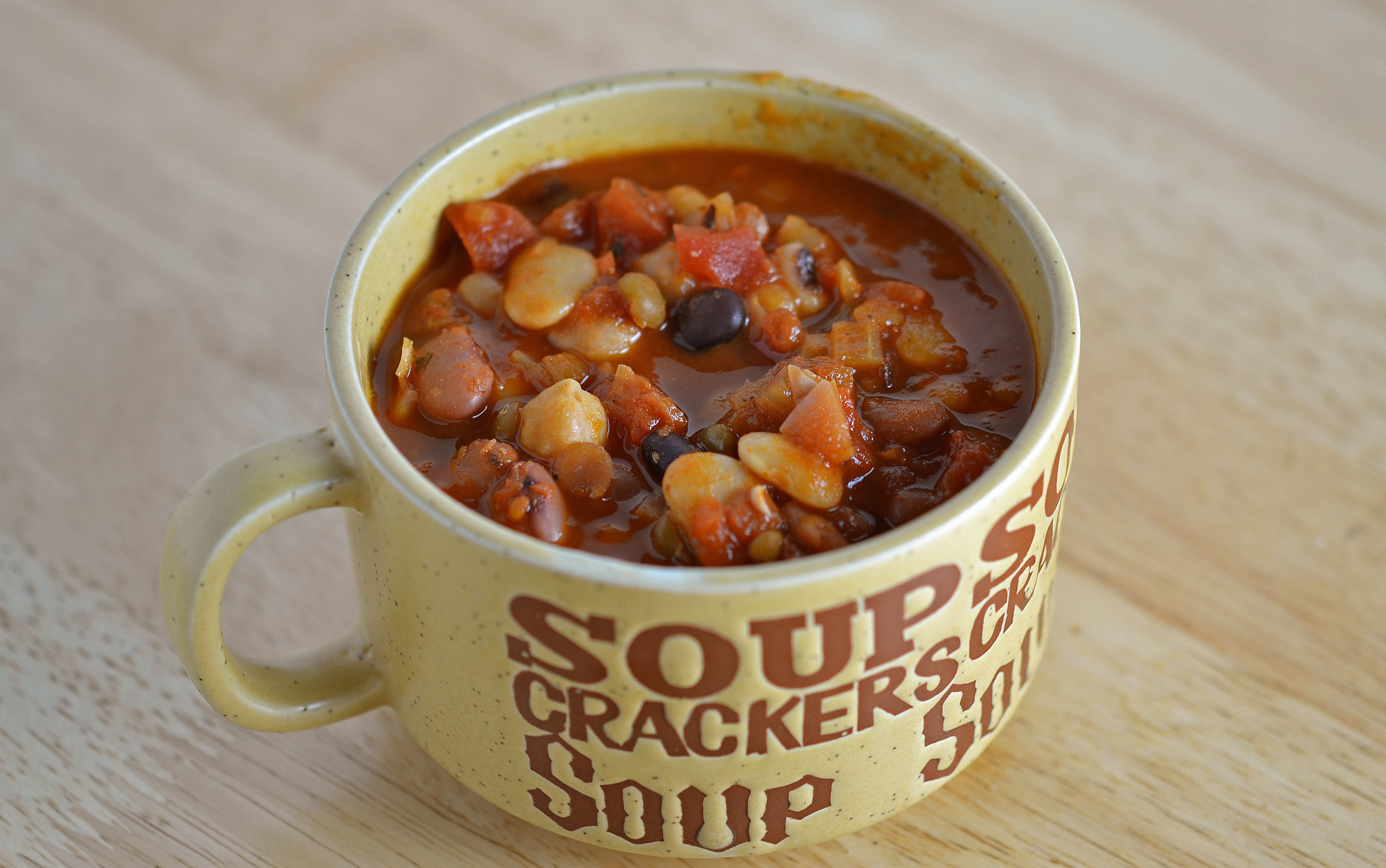
I’ve been on a hearty stews kick, a reasonable trend given the bitter cold of late. Yet every now and then I lose the patience needed for preparing these dishes, wanting a dish that can pack just as much flavor for a fraction of the time. Though there is really no substitute for time, there are quality shortcuts that mirror the tastes of the more time-consuming varieties. Enter this beauty – ready in under 30 minutes, even you may be fooled into thinking this Cajun 15-Bean Soup took hours to cook.
This recipe was probably one of the first dishes I ever made on my own – little history fact, my culinary interests weren’t realized until my second year of college. Prior to then, pre-prepared dinners and the microwave were my specialty (commence moment of shock). When I went vegetarian, I realized that cheese sandwiches just weren’t going to cut it, so cooking became a means of survival. My mom introduced me to this bean mix, and the recipe included here is the product of multiple trials. This variegated collection is packed with nutrients, and is SO easy to prepare. You can essentially add anything, from sausage to saffron.
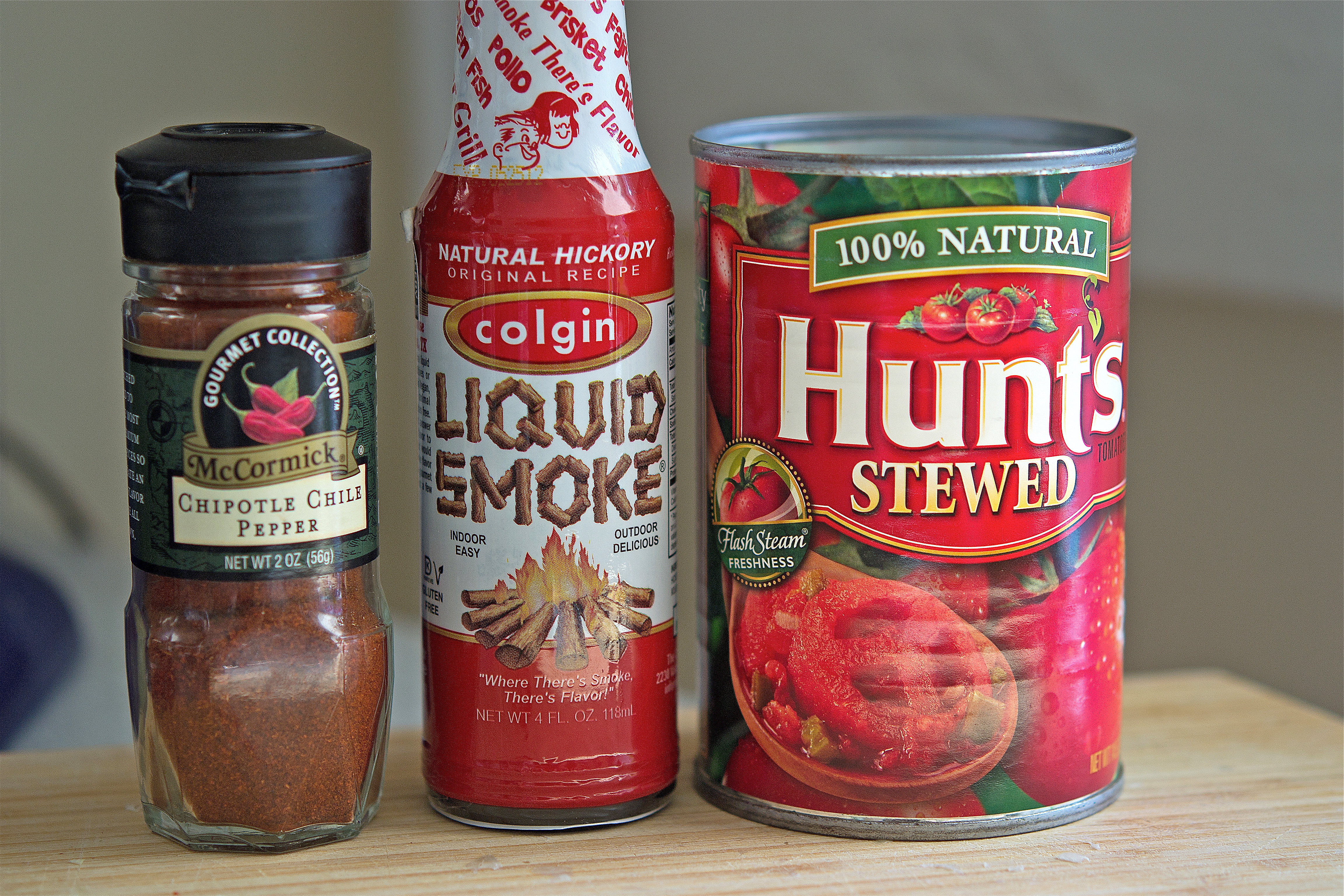
The recipe on the back of the package calls for a ham hock (and normally includes a spice packet, which I don’t use) – while I am all about that flavor, I wanted something that could be equally as flavorful for half the price. Enter this recipe’s trilogy of secret weapons – chipotle chile pepper, stewed tomatoes, and liquid smoke. Chipotle is in and of itself a unique flavor – it adds a smoky, peppery element to the soup that traditional chili powder would lack. The stewed tomatoes are key – they give off the impression of a stew that’s been simmering away for hours, a depth normally achieved by the ham hock. Most important of all three is the liquid smoke – as real smoke that has been bottled in a liquified form, it adds a great finish that perfectly masks the lack of meat. Trust me, you won’t miss the ham one bit – click HERE to see how to make this delicious soup.
For the musical pairing, I wanted to showcase this soup’s ability to achieve such a flavorful result with so few ingredients. That led me to consider piano arrangements of orchestral works – a route often taken by composers hoping to reach a wider audience without the need to organize an entire orchestra. I felt that Igor Stravinsky’s Trois mouvements de Petrouchka (Three Movements from Petrushka) pairs well with this recipe. Even though this piece draws on material from Stravinsky’s ballet of the same name, he was adamant that it is not a direct transcription (like the way this soup is not a direct translation of the original recipe). Stravinsky wrote this piece to give pianists the opportunity to perform his music, as well as demonstrate their technical aptitude. Given the simplicity and affordability of this recipe, I hope it too will be reached by a wider audience. I’ve included a recording of the piece by pianist

http://www.youtube.com/watch?v=9v4vonP1XAQ&feature=related

Sources Cited:
“Trois mouvements de Petrouchka,” Wikipedia.com

When Decadence meets Elegance

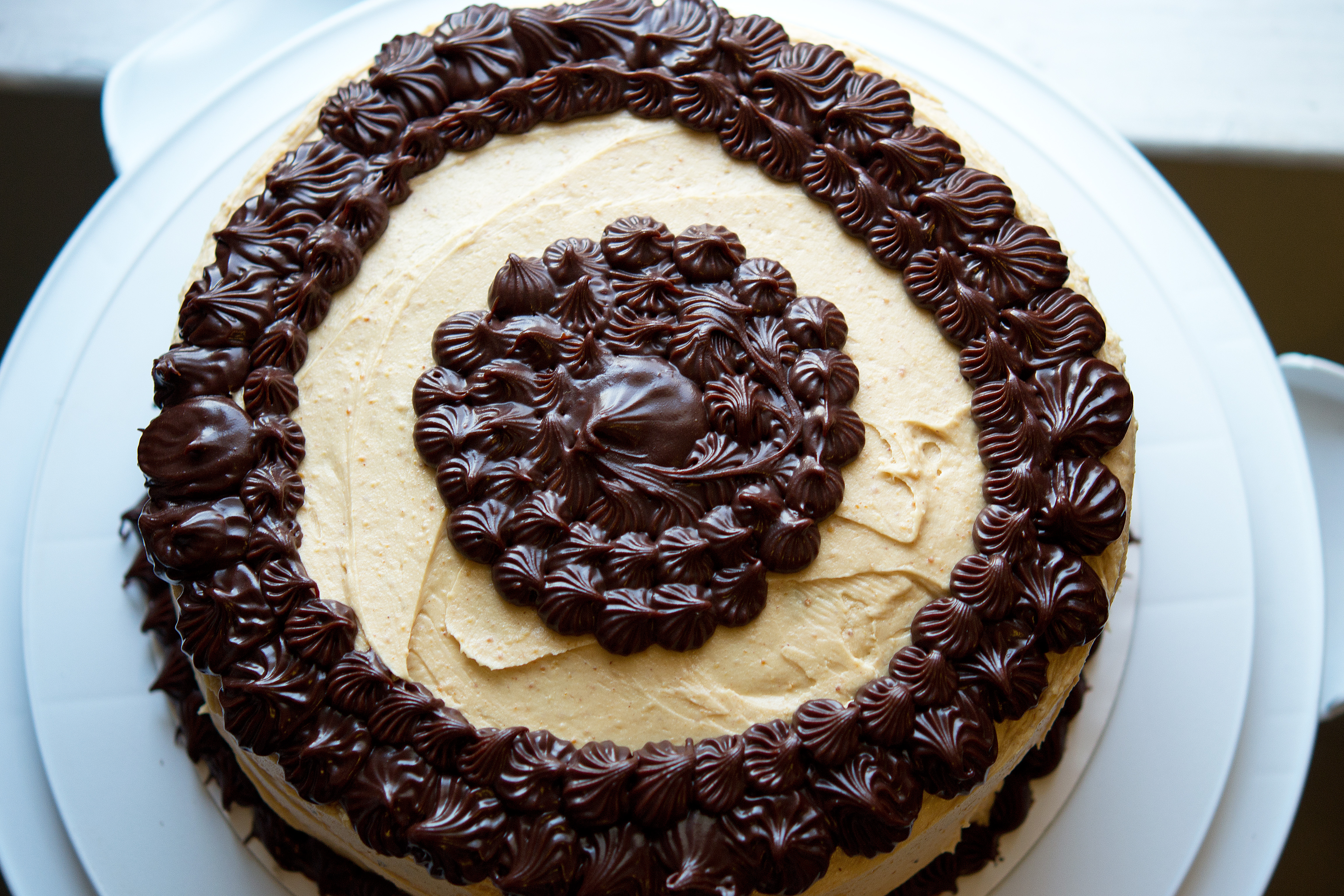
There are very few who will say no to a peanut butter/chocolate combination (I’ve stressed the draw of this “super couple” a number of times on this site). That being said, I can’t quite say there’s been a cake as dangerously addictive as this one – the perfect balance of a rich, dark chocolate cake with a light, heavenly peanut butter frosting. I had volunteered (again) to be the baker for our office’s January birthdays celebration – it’s a busy time of year, so I wanted to bring in an extra-special treat. This Dark Chocolate Cake with Peanut Butter Frosting and Chocolate-Peanut Butter Ganache DEFINITELY was just that.
There is dark chocolate, then there is this cake – I decided to give Hershey’s Special Dark cocoa a shot for this cake. The result was a cake that was nearly black. It was a rich cake, no doubt, but my fear that the chocolate flavor would be WAY too intense was unfounded. I’ve discovered that chocolate cakes made with boiling water = amazing. Though it makes the batter appear more like chocolate soup, its function is helping dissolve the cocoa butter fats into the batter, resulting in a smooth, rich finish. It also means that the cakes will be that much more difficult to remove from your pans, so be prepared with parchment (or grease and flour the pan).
The frosting was the winner of this cake – despite having nearly 3 cups of peanut butter, the result was a “light, airy” frosting with just the right amount of sweet and salty. In fact, it might just be one of the best frostings I’ve made yet. I had originally thought about decorating it with Reese’s Peanut Butter Cups, but chose to make my own chocolate-peanut butter ganache – people were practically licking this stuff off their plates (it was also a gorgeous alternative). All-in-all, this was a fabulous cake that had all the right elements. I highly recommend making this…asap – click HERE to see the recipe for this showstopping dessert.
To complement the “darkness” of this cake, I thought a piece that has a bit of a dark side would be appropriate. At the same time, it needed to be a work with a certain elegance to mimic the balance of this beautiful cake. This led me to the Czech composer ‪Leoš Janáček‬, whose music is known for both its volatilities and subtleties. The piece I felt would be perfect for this pairing is his String Quartet No. 1. Composed when ‪Janáček‬ was 69, the piece is based on Tolstoy’s novella, “The Kreuzter Sonata” – a dramatic tale of marital distrust, fury and ultimate despair. The piece itself is highly evocative, filled with powerful harmonies that are countered by delicate refrains; a beautiful balance. The recording below is with the Alban Berg Quartet – enjoy!

http://www.youtube.com/watch?v=sc-DZWoU52E

Sources Cited:
“Janáček, String Quartet No. 1, ‘Kreutzer Sonata,’” Earsense Blog

A Dish of Epic Proportions

Despite my endless rhetoric on the difficulties with cold weather, winter does allow me to indulge in some of my favorites: hot tea, fuzzy socks, curling up by a fireplace, and of course, rich and hearty stews. When I decided to invite some friends over for dinner, it just so happened to be one of those bone-chilling evenings that begged for a rich meal. I had been dying to make a seriously good chili for a while, and this was the golden opportunity. Ladies and gentlemen, let me introduce you to the godfather of all chilies: Slow Braised Chili con Carne.
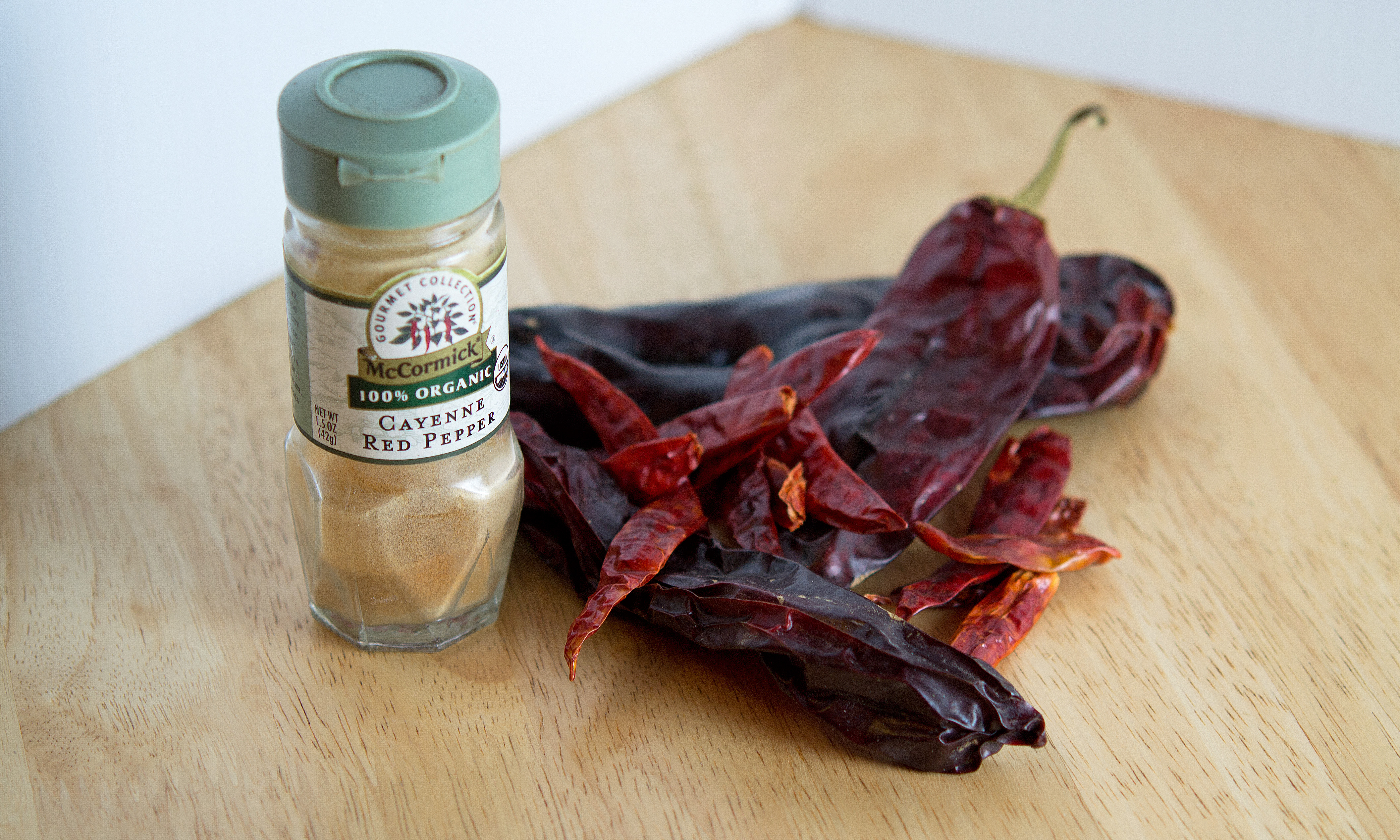
Chili con carne (chili pepper with meat) is a stew meant to be thick and hearty. Most standard chilies use ground beef, but this one calls for whole chuck. The difference is undeniable, and the payoff is unbeatable. For the “chili” part, there were no less than THREE different varieties, all pureed into a sinfully spicy mix that is added to the pot at one’s own discretion (my personal taste used practically all of it).
While the standard ingredients were phenomenal, it was the two “B’s” and “C’s” of the recipe that set this chili apart: Bacon and Beer, Coffee and Chocolate. For those of you thinking that I’m utterly insane, I cannot emphasize how much you will fall in love with the chili. The bacon is an obvious plus (everything’s better with it), while the beer helps to tenderize the chuck. The coffee intensifies the meat’s flavor (yet is indiscernible itself), while the chocolate (added at the very end) provides a beautiful depth. The result is one of the richest, most delicious chilies you will ever try (there were no leftovers, not even a bite) – click HERE to see how to make this epic stew.
As I mentioned earlier, this is an epic chili. It embodies a number of flavors, yet manages to transform them into an intoxicating whole. This immediately called to mind the term Gesamtkunstwerk, German for “total work of art.” This was an aesthetic pioneered in opera by the German composer Richard Wagner. Wagner embraced the rich textures and harmonies of  large-scale works, coupling visual and dramatic elements with his music to augment the overall experience. For this particular dish, I chose the Ouverture from Wagner’s Der fliegende Holländer – an opera based on the legend of a man doomed to sail the oceans for all eternity until he finds true love. Like the legend, this dish requires a great deal of patience and time – its richness also perfectly complements the complexities of Wagner’s scoring for the work. The recording I’ve included is with the Chicago Symphony Orchestra under direction of Sir Georg Solti – enjoy!

http://www.youtube.com/watch?v=6nc69Pp2MgM