
 What a crazy, wonderful, insane summer it’s been! I visited Canada for the first time, went backpacking through the White Mountains, cycled who knows how many miles, and cooked a ridiculous amount of food…which I’ve been terribly remiss in sharing on this blog. Blame the summer weather, but I’ve hardly had a moment to compose (much less edit) photos and text. I’ve documented a TON of creations over the summer, filing them away with a goal of having them posted at some point in the future…so I’m finally back at it with Lamb Dhansak in continuation of the South of the Orient Series, featuring my boyfriend’s amazing recipes (influenced by his travels in Southeast Asia).
 Dhansak is of Parsi origin, with influences from both Persian and Gujarati cuisine. The name itself is from the state of Gujarat (in west India), where dhan stands for “grain” and sak for “stewed vegetables”. The dish has a place in Parsi tradition, often served in honor of a loved one’s passing. Parsi households will abstain from eating meat for three whole days following the death of a family member. On the fourth day, this “fast” is commonly ended with a meal of dhansak. Traditionally made with goat or mutton, Parsi households will often modify the ingredients to merit the dish’s enjoyment year-round.
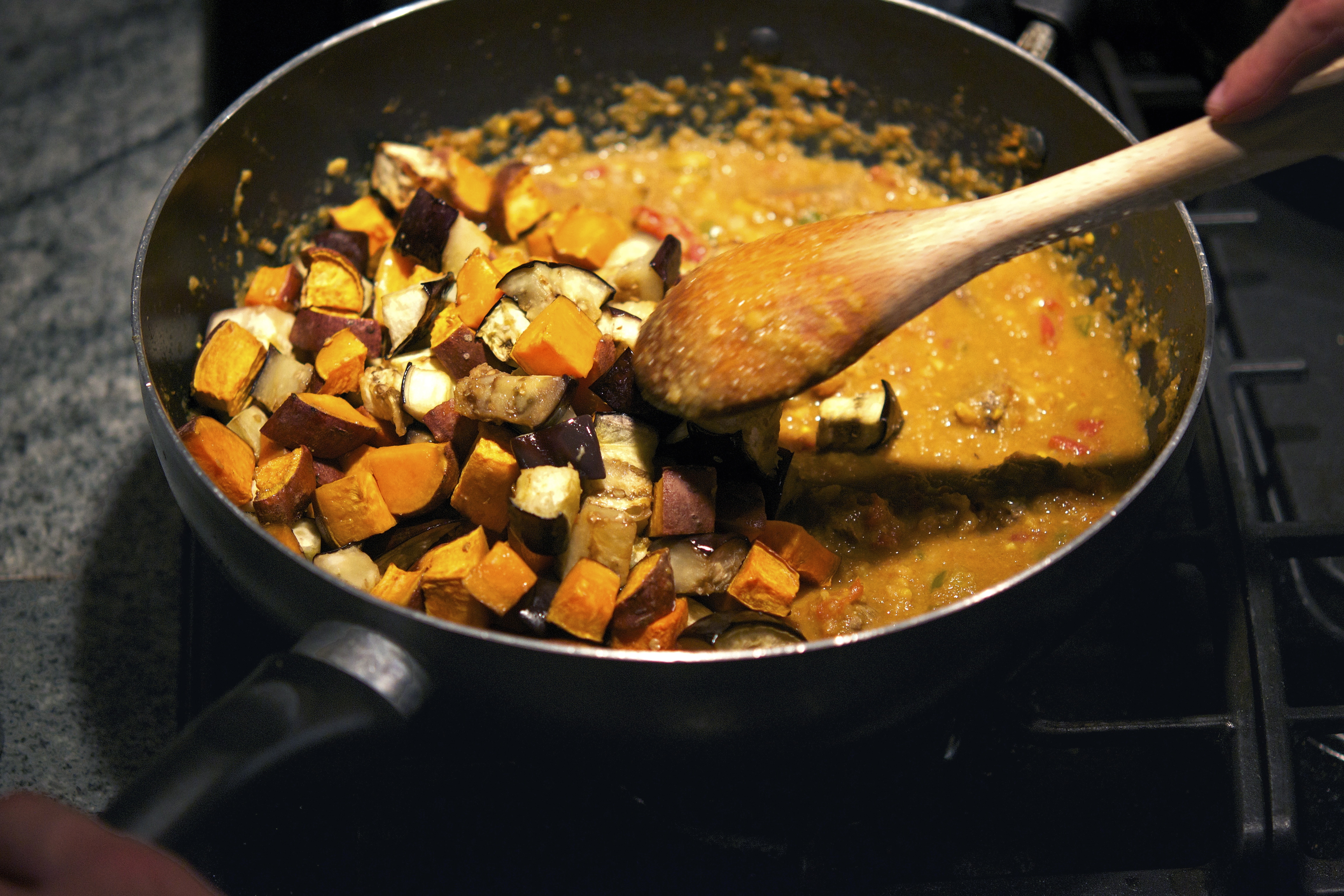 This dish was intense – lots of flavor, tons of ingredients, and hearty to boot. You can omit the lamb if you’re seeking a vegan-friendly option, just be sure to use another filler in its stead. My favorite part of the recipe is the use of roasted vegetables. It’s a first (for me) in Indian cuisine, and works extremely well in the setting. Spinach adds a shock of color, while the spices and lentils imbue the entire dish with a golden hue. Aside from being absolutely delicious, it is chock-full of nutrients and makes for great leftovers. Click HERE to see the recipe!
 While Dhansak is far from having ominous implications in the Parsi culture, it is rarely served around or during felicitous occasions. It thus seems appropriate to draw a connection to its tradition for the musical pairing. Death can be a powerful force in any context, to which classical music can lend a responsive and passionate voice. From Mozart’s Requiem to Barber’s Adagio for Strings, music often expresses that which words cannot. The emotional intensity provides an unspoken solace and understanding to the bereaved, whether or not the work was written with said intention. Such music is a reminder of life’s wonders and inexhaustible beauty.
An example is the nine suites of the Bachianas Brasileiras, by Heitor Villa-Lobos. Written between 1930 and 1945, the suites are a beautiful fusion of Brazilian folk music with the contrapuntal and harmonic structures of the Baroque style. Villa-Lobos had a profound respect for Bach, and sought to pay homage to the composer through these suites. Two movements from the collection (in my opinion) present a remarkable degree of emotional depth, coalescent in their beautiful yet tragic milieu. The first is the “Prelùdio” of Bachianas Brasileiras No. 1. The below rendition, from the 2008 Verbier Festival, was performed in memoriam of the renowned cellist Mstislav Rostroprovich. The suite is scored for an orchestra of cellos, which is absolutely stunning:
The second is the “Aria (Cantilena)” from Bachianas Brasileiras No. 5 – the first time I heard this piece, there wasn’t a dry eye in the house. Similar to the first, this suite is scored for an orchestra of cellos, with the addition of soprano solo. The below recording features Kiri te Kanawa, Lynn Harrel, and Cello Ensemble:
Both pieces are absolutely breathtaking – I hope you enjoy them as much as I do.
Sources Cited:
“Dhansak,” Wikipedia.com
“Dhansak,” My Indian Food
“Bachianas Brasileiras,” Wikipedia.com





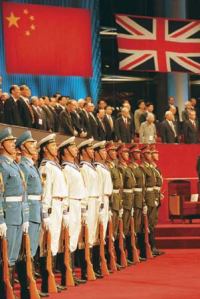 the internationally renowned musicians. One of the most notable graduates of that class was composer Tan Dun – his style is a unique fusion of Western, traditional Chinese, and experimental styles. In 1997, Tan Dun was commissioned to write a piece celebrating a truly historic moment for China: the return of Hong Kong to Chinese sovereignty from British rule. The work was premiered at the reunion ceremony (pictured right), titled “Heaven, Earth, Mankind – Symphony 1997”. The symphony is a large-scale work for solo cello, Bianzhong bells, a full orchestra, and children’s chorus. It is a celebration of the old, the present, and the future, paying tribute to the values of ancient China while looking forward to a new global community. The below videos are two excerpts from the work, titled “Jubilation,” and the “Song of Peace” (the videos are a little bizarre, but are the only two I could find on YouTube) – enjoy!




















 THE CLASSICAL KITCHEN