
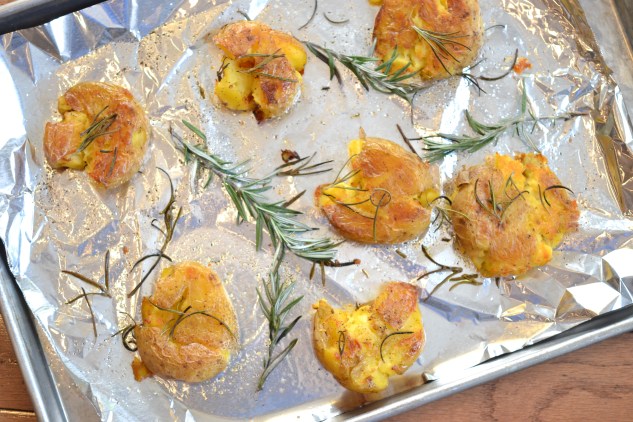
 I have this funny habit of cooking a ton when it gets cold outside, and then neglecting to post here. Let’s call it my blogging hibernation…for lack of anything else creative coming to mind. And this is a frivolous excuse considering we have had a very mild winter. SO to compensate for my truancy, I’ll share two dishes in this post involving one of my favorite food groups: potatoes! Potatoes make for an exceptional comfort food in the cold weather…when it’s properly winter. Read on to learn more about these two lovely dishes: Rosemary Smashed Potatoes with Dill & Yogurt Sauce and a Coconut & Peanut Red Lentil Stew.
 From a historical perspective, the potato carries a lot of weight. It was first cultivated in modern-day Peru between 8000 and 5000 BC. The name as we know it today was a result of the Spain conquering the region, at which time the “conquistadores” named it patata. After introducing the crop to Europe through the Columbian exchange, the potato would grow to become a (if not the) worldwide staple. Yet the Spanish introduced only a handful of varieties from the Americas, which – when blight struck in the late 19th century – led to the Great Irish Famine….oof. Another fun fact is that the potato and sweet potato, albeit similar in appearance, are distant relatives. The former belongs to the nightshade family (Solanaceae) while the latter to the morning glory family (Convolvulaceae). You don’t actually need to know any of this to cook these two dishes – I just think it’s super cool.
 SO let’s come back up for air after that little tangent. These smashed potatoes are actually quite simple to make. The keys to success are to find potatoes that are small enough and to be patient with the smashing process. Why? Because a few will shatter or break cleanly in half (not pictured…though there were plenty). One thing I can guarantee is that the broken ones will be just as tasty, so go crazy and embrace the imperfect. You can go with or without the yogurt sauce – but the dill and yogurt combo is irresistible in its own right. Click HERE for the recipe to these salty pillows of joy.
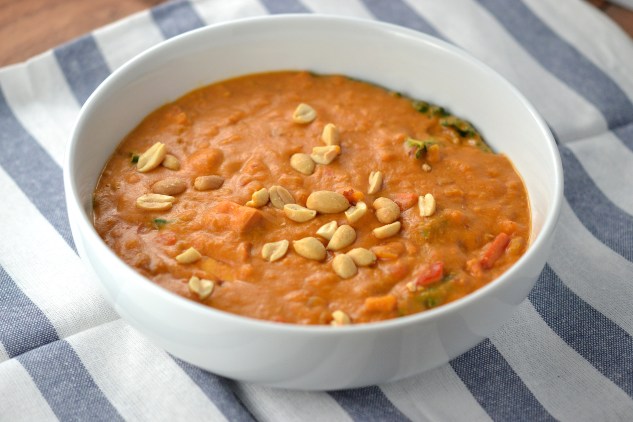 Winter and stew are like mornings and coffee – it’s impossible to make it through the first without the second (I’m aware I just confessed to loving coffee a little bit too much…moving on). What I love about this stew is you can prep most of the ingredients in advance – from the mirepoix to measuring out the spices. I prepped most the ingredients the morning of the dinner party, storing them in the fridge until half an hour before I started to cook. It made the preparation so so easy (and hassle-free).
 Another thing I like about this stew is its “heartiness” as a vegan dish. You purée half of the ingredients at the end, to create a thicker consistency. There is an optional spicy quotient – I used two dried chilies, with the seeds, reconstituted and minced. You can use less (or more if you are a little crazy). This stew also keeps very well, and is more flavorful on day #2 – thanks to sitting with those lovely spices overnight. Whether this is for a dinner party or a week of lunch prep, this one is a keeper. Click HERE for the recipe to this hearty and healthy winter comfort.
 Given the centrality of the potato’s “staple” status for this post, I wanted to pair these dishes with a work that could convey their colorful depth while staying true to this concept. That brought me to the iconic lied (or lieder, for plural): which is German for “song”, and came to represent a musical style that embraced poetry and voice.

The man, the legend -Robert Schumann
The lied was (and still is) a staple for many composers. The style dates back to the 12th century, where the majority of the writing was monophonic. Yet as the the art form evolved, polyphony prevailed as voice plus piano (or orchestra) became the prevalent structure. The lied truly flourished in the 18th and early-19th centuries with the advent of Romanticism. Beethoven, Strauss, Brahms and other great composers produced some of their most epochal works as lieder; specifically as song cycles (where a theme or story ties together all the lieder within a set). Perhaps my favorite example of a song cycle is Robert Schumann’s Dichterliebe (Poet’s Love). Schumann wrote the work in 1840, impressively within the span of a week. The music is set to a series poems by Heinrich Heine: painting the tale of a man enraptured by love, only to hopelessly discover it is an unrequited passion. The below recording features the tenor Fritz Wunderlich, whose performance of Dichterliebe is still held as the gold standard. The songs arequite short, and perhaps the two most famous in the series are the opening, “Im wunderschönen Monat Mai” and “Ich grolle nicht” at 7:17. Enjoy!
Sources Cited:
“Potato,” Wikipedia.com
“Sweet Potato,” Wikipedia.com
“Lied: GERMAN SONG,” Encyclopaedia Britannica
“Schumann’s Dichterliebe,” Hampstead Arts Festival
“The Schumann Chamber Series: Year Four,” Emmanuel Music Program Notes
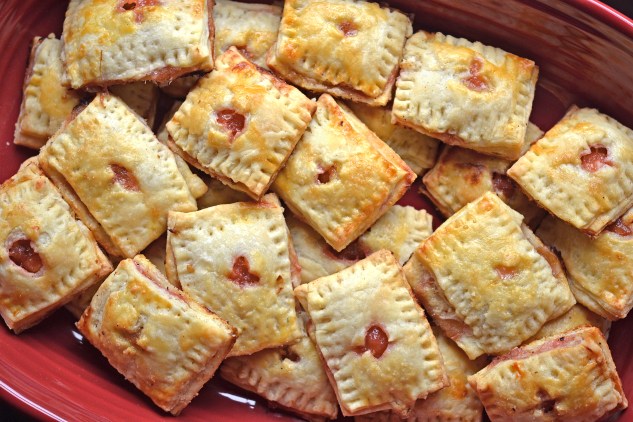 Summer is perhaps one of the best seasons for eating – weekends are for cookouts, piles of colorful produce flood farmers’ markets, and restaurants eager to open their patios and porches get creative with menus. Since I started this blog, there has always been one dish that best defines my summer repertoire: pie. I’ve made lots of pies, and have tried nearly every approach to pie dough (including a
  I found this rhubarb at the farmer’s market – big, ruby stalks of the stuff. Their pigment comes from varying levels of anthocyanins (the same compound that colors blueberries and black rice; ahhhh science). Even though it’s a vegetable, rhubarb is often prepared in dishes that are fruit-forward. The tart flavor and celery-like texture lend themselves well to compotes and jams and pie fillings. For this recipe, it’s simmered with nothing more than sugar; and you don’t even need to really stir it. You want the mixture to have as little liquid as possible when done, so it’s easy to work with when filling the pies.
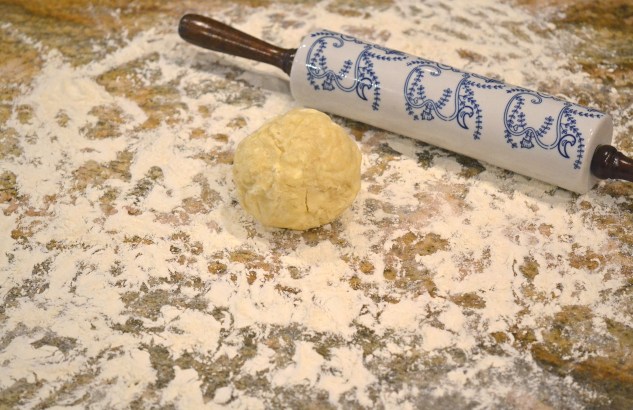 The trick to handmade pie crusts is to keep the dough very cold; from start to finish. It can be frustrating…especially when you’re working on a hot summer day, but it’s worth the patience. If you have to refrigerate the dough halfway through making it, that’s OK. It’s also a little messy (with all the flour) but again, worth it. I could have chilled the dough a bit longer before starting the assembly process…but was watching Westworld and became too focused on keeping up with the plot twists. All the same, they tasted great!
  Summer and pie are a perfect pair, rousing memories of lazy, hot days with sweet iced tea and picnic blankets. Today was a perfect example of that kind of weather…although I spent a good deal of it beneath a fan with the A.C. blasting. In thinking about a musical pairing, one of my favorites came to mind –
  Avocado – the unofficial mascot of millennial culture. It’s a pretty awesome food, with a versatility that makes it the kind of friend you always want to have around. From pasta sauces to creamy desserts to savory appetizers, this fruit has it all. So when thinking of how to feature avocado, I turned to my all-time favorite meal: breakfast. This is part six of my mini series “Rise and Shine”. So far the series has featured my adventures with brunch, and I thought it high time I chronicled the dishes that I enjoy every morning before work:
  Let’s start with the toast – this is a dish that has taken the internet by storm. It’s simple, delicious and never gets old. As a spread, it’s also a healthy substitute where butter or jam are the traditional go-to’s. What’s perhaps more interesting is the many ways people interpret the increasing popularity of the dish: from it’s alleged necessity as an everyday staple in the “bourgeoisie’s diet” to being a symptom of our continued “fetishization of food.” I’m a millennial, so I’m not helping to disperse any of these myths…but it’s a great and filling breakfast. I for one think making it at home is a fantastic option, versus paying $30 at a Brooklyn brunch enclave for a few slices.
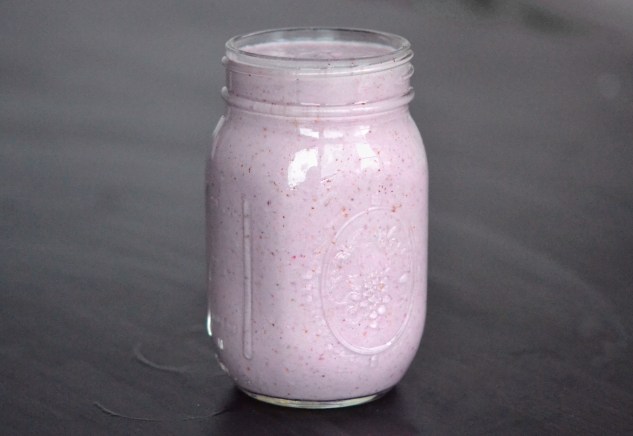
  Smoothies are a great way to start the day – you can pack in a ton of nutrients, and mix it up based on what’s in season (or on sale). When I reflect on the ingredients that are must-have’s, I’d say they are a banana, some yogurt, nuts, and of course avocado. The yogurt and nuts are the protein: which make this a really filling meal, and give you the energy to kick off your day. I always use bananas since they are delicious, but the avocado is what gives the smoothie a thick and creamy consistency. You can even add a little honey, but I find the fruits to add enough sweetness.

 The promise of these dishes is enough to inspire even the sleepiest to rouse on a weekday. So in considering a piece that worked well with these dishes, I came across Gustav Mahler’s “Frühlingsmorgen” (Spring Morning) from his collection of Lieder und Gesänge. Mahler was known to devote his mornings to composing: pouring himself into his scores and harmonic textures, then indulging himself in the afternoon with mountainous vistas and lakeside excursions. This makes the “Frühlingsmorgen” all the more apt – both of the dishes in this blog post are colorful, flavor-forward and bright: reminiscent of spring, if you will. This particular song falls within Volume 1 of the collection: written between 1880 and 1881. The song is labeled “Gemächlich, leicht bewegt”, which roughly translates to “with leisurely movement”. The following video features the German lyric baritone Dietrich Fischer-Dieskau and the musical icon Leonard Bernstein on piano (though there are plenty of fantastic recordings with sopranos on YouTube as well). Enjoy!!
 New Yorkers are having an insanely cold weekend…which is a great excuse to stay inside, wear thick socks, and have Netflix/Hulu to keep you company. But this forced captivity means limited access to food – and considering I would feel like a terrible human in ordering Seamless (thus forcing a poor delivery guy to brave the cold himself) I had to get creative. I somehow convinced my carnivorous boyfriend Tom to go vegetarian for a day (cold weather does funny things to people) and pantry staples came to our rescue for this
  There are a ton of falafel recipes floating around on the internet (shameless plug for a recipe on this blog:
  What’s great about this recipe is that it comes together fairly quickly. The “batter” rests in the refrigerator for about 30 minutes, making it easier to roll the falafel balls…but you can skip this step if you have a cookie scooper or like the idea of “rustic” falafel. And if you’re really hungry and can’t bear the thought of going another second without food, the batter is basically hummus! No matter how you enjoy it, it’s a great quick meal –
  In considering a musical pairing for this recipe, I looked for a piece that could complement both the simplicity of the recipe and its wintry context. My choice of Faure’s









 THE CLASSICAL KITCHEN