Challenge Accepted

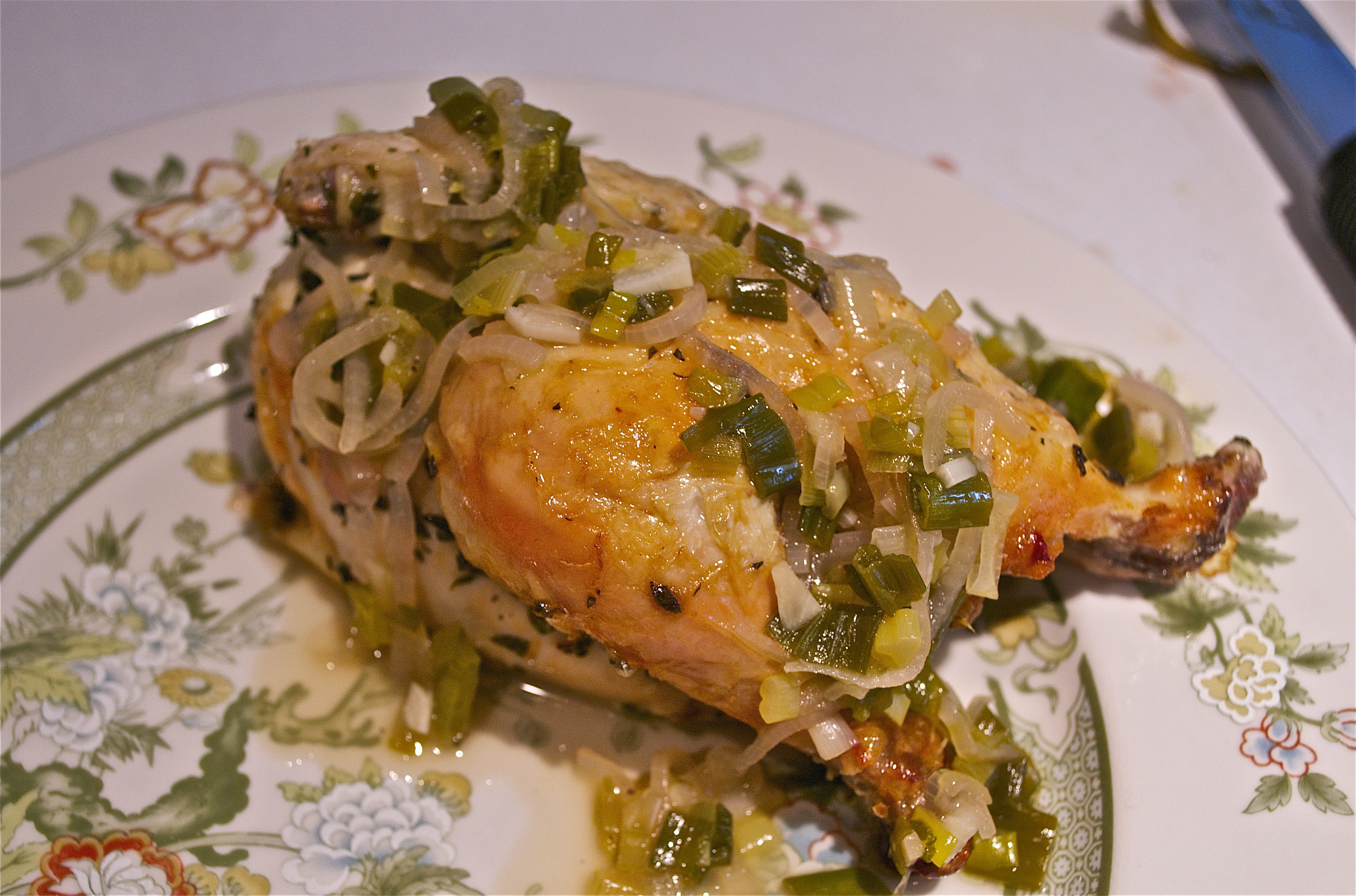
Iron Chef has transformed the way we perceive culinary challenges – the “blood, sweat, and tears” of cooking finally has a stage, and food’s competitive qualities have been taken to a whole new level. The show certainly left an impression on my mom: a business-savvy, energetic woman who loves the prospect of a challenge. So naturally, my visits home are often paired with an Iron Chef-like arrangement. My most recent challenge: Cornish Game Hens…well, that took me through a loop considering a) I had never prepared these before, and b) couldn’t even begin to imagine how they were suited for spring fare. After stumbling through several menu options, I finally landed on one that suited my standards: Roasted Cornish Hens with White Wine-Scallion Sauce.
Cornish hens are a peculiar kind of bird: they aren’t actually a game bird, but in fact a hybrid of Cornish Game and the Plymouth Chicken. Though identified as “hens,” these birds can be either male or female, and often weigh no more than 3 pounds. I was pretty floored when my mom asked me to prepare these hens for the dinner party she was hosting, especially since I’d always thought of them as that “other” holiday bird (i.e. the simpler alternative to roast turkey).
My trick in making these hens “Spring-friendly” was a combination of REALLY fresh herbs and seasonal ingredients, like scallions and shallots. Complementing these birds with strong flavors is vital considering the meat has a rather dull taste on its own. Rather than stuffing them with actual stuffing (a holiday trend), I threw in a few aromatics to help infuse the meat with more flavor. The result was an elegant, flavorful dish that had all the right notes of Spring. Our guests enjoyed nearly every last bite of their individual helpings (yet in all honesty, I’ll probably reserve future attempts with Cornish hens for the colder months) – click HERE to see the recipe for this unique dish.
For dessert, I wanted to make a cake that packed a punch but was a lighter afterthought to the entree. I’ve got a crush on vanilla beans, so shelled out $14 for TWO beans (that’s not a typo) and made a Golden Vanilla Bean Pound Cake that was out-of-this-world good. The trick with this cake is having your butter and eggs at ROOM temperature. Yes, this means shelving your fears of leaving them unrefrigerated and just letting them sit out – if I can leave you with any piece of advice when it comes to baking, this is it.
In line with the menu’s seasonal trend, I topped each slice with sherry-macerated strawberries that paired beautifully with the cake’s buttery, golden texture. Feel free to pair it with whatever strikes your fancy – ice cream, caramel, etc. Though simple to make, this cake is definitely not simple in taste, and makes for the perfect weeknight indulgence – click HERE for this heavenly treat.
For this pairing, I thought it appropriate to pair a piece of music that took on a classic, venerable topic and gave it an avant garde spin. That led me to Stravinsky’s Firebird Suite. In folklore, the firebird is (more often than not) a coveted prize that induces a challenging quest by the story’s hero. Stravinsky acknowledged his own reservations on the “challenge” of composing the music for this ballet (similar to my reservations on preparing this dish):

The Firebird did not attract me as a subject. Like all story ballets it demanded descriptive music of a kind I did not want to write..However…I know that, in truth, my reservations about the subject were also an advance defense for my not being sure I could.”

The music is an entirely different matter – even though it was his first, it is perhaps the most widely recognized and acclaimed of Stravinsky’s ballets (even more so thanks to Disney’s Fantasia 2000). The opening passage (alternating between thirds and seconds of a tritone in the cello, bass and viola lines) set the “supernatural” setting of the hero’s quest, which ultimately ends in a truly majestic Finale (an ending that is admittedly uncharacteristic of Stravinsky). Yet the piece still demonstrates what will become the composer’s greatest qualities in later works. The primitive style that would take on a whole new level in Rite of Spring finds a starting point in this work, with metric dynamism that keeps demands a keen concentration from performers and listeners alike. Two examples being the offset downbeat of the Danse Infernale, and the 7/4 time signature of the Finale. Additionally, the orchestration of the work was substantial for the time, with Stravinsky even claiming it to be “wastefully large.” Despite this claim, the orchestral force brings a rich quality to the piece that has truly come to define the music. For the recording, I found a fabulous video of Claudio Abbado with the Lucerne Festival Orchestra‬ – enjoy!

http://www.youtube.com/watch?v=WI-MG_CXYiY

Sources Cited:
– “Cornish game hen,” Wikipedia.com
– “Firebird (Slavic Folklore),” Wikipedia.com
– Huscher, Phillip. “Program Notes: Igor Stravinsky – The Firebird” Chicago Symphony Orchestra
– “About the Piece: The Firebird (complete),” LA Phil


A “Fiery” Evening

I was walking with my friend TJ over to his place to make dinner the other day, when we both saw it: a towering cloud of black smoke billowing into the sky (see photo at the end of this post). We walked closer towards Boylston Street and realized said cloud was the coming from the Prudential Center…we later learned that an 115,000-volt transformer had caught on fire at the adjacent HIlton Hotel. With the cacophony of sirens and a dark, smoky sky just outside our window, we prepared a spicy Asian meal that was all too fitting for the “fiery” event we had just witnessed: Spicy Chicken Chop Suey and Sesame Green Beans.
Chop suey is believed to have originated in Taishan (a coastal city in the souther Guangdong province), and was introduced to the United States by Chinese immigrants during the early 19th-century. It’s literal translation means “assorted pieces.” The traditional preparation includes a meat with chopped vegetables and aromatics, which are all cooked in a starch-thickened sauce and served over rice or noodles.
This dish was a definite winner – though the ingredient list seems substantial, most are pantry items you will have on-hand for the repeats you will guaranteed be making of this dish. Wanting a spicy kick, I decided gave it an extra dose of pepper flakes. Feel free to substitute any meat for the chicken, and any other vegetables for that matter (carrots and sugar snap peas would be excellent!) It can ultimately be an “assortment”  to your liking – click HERE to see how to make this spicy dish. For the side, I just blanched the green beans, then pan-seared the heck out of them in a bit of olive before tossing in some cloves of garlic, sesame oil, (lots of) red pepper flakes, salt and pepper. Delicious!
Unable to shake the “fire” theme, my musical pairing for this meal is Manuel de Falla’s “Danza ritual del fuego,” from El Amor Bruj0 (Love, the Magician) – 35 minutes in length, this Gitanería (gypsy ballet) was originally scored for an “assortment” of performers: cantaora voice, actors, ballet dancers, and chamber orchestra. It was adapted the following year for orchestra and mezzo-soprano. In the work, our heroine Candela is desperate to drive away the ghost of her dead lover, and appeals to the fire-god in hopes of vanishing his haunting spirit. The “Danza ritual del fuego” marks her attempt to do so, in which she seduces her lover and pushes his spirit into the flames. The work has a bohemian flair, yet maintains de Falla’s Spanish touch. The recording below is with the Chicago Symphony and Daniel Barenboim, enjoy!

http://www.youtube.com/watch?v=auRUxPPqDcQ

Sources Cited:
“Chop Suey,” Wikipedia.com
“Ritual Fire Dance (Falla)” Wikipedia.com

(taken on my phone while walking with TJ)

A Star-Worthy Spread

The Academy Awards: an evening of glamor where the “who’s who” of Hollywood gather to honor the year’s most celebrated films. For a hostess, it is the perfect excuse to throw a party – but this couldn’t be just any part, it had to be in true Hollywood form: red carpet entrance, formal attire, and of course classy hors d’oeuvres.  For this post, I though I would share three of the dishes featured in the extensive spread: Coconut-Crusted Chicken Tenders, “Eggstremely Good” Deviled Eggs, and Fiery Jalapeño-Bacon Bites.
It’s worth mentioning that I created appetizers to pair with each of the various film nominees. These chicken tenders, for example, were grouped with The Descendants: a film starring George Clooney that takes place in Hawaii. Though simple in concept, the flavor of these was extraordinary (and a wonderful twist on the standard breaded variety). They can be served with any dipping sauce, though sweet chili sauce works quite beautifully – click HERE to see how to make these tasty chicken tenders! 
I think deviled eggs have received a bad rep as the appetizers found at any and every gathering, devoid of flavor and character. In reality, they provide the perfect canvas for creativity: wasabi, curry, even smoked salmon are all flavors to try! On top of that, they are great for large parties (budget-friendly!) and such an elegant addition to any affair. I paired these with the film Extremely Loud and Incredibly Close (as their title suggests).
While deviled eggs are a classic, a solid foundation is vital to their success which, of course, starts with boiling. Too often are we plagued by hard-boiled eggs with gray, chalky yolks. Yet there is a trick to guarantee a perfectly cooked center every time – removing the eggs from the heat once the water reaches a boil. I was apprehensive of this method at first glance, though it is utterly foolproof. Click HERE to see the recipe for these “eggstremely good” bites!
These aren’t just spicy…they are downright addictive. Who would have thought the simple trio of jalapeño, cream cheese and bacon could have so much moxie? Warning: you will NOT want to stop eating these once you’ve started…a fate many of my guests fell victim to. I paired these with the film Girl with a Dragon Tattoo given their dangerous, “fiery” appeal. I guarantee these WILL be the star at your next event – click HERE to see how to make these addictive bites.
Movies are an addictive diversion: the excitement, the passion, the humor – it compels us to buy tickets or press play time and time again. With that in mind, I wanted a piece that truly captured the energy of the “movie magic”; a piece that pulls you in, and has a palpable, compelling story. Funnily enough, I was only recently introduced to this work, yet it is the ideal match: Poulenc’s Sonata for Violin and Piano. Composed during the German occupation of Paris, the piece is replete with passionate energy. It is dedicated to Federico García Lorca – a Spanish poet assassinated during the Spanish Civil War. The first and third movements are driven by a dark, potent energy that bring listeners to the edge of their seats, while the second evokes a deeper emotion for which we have no words (though Lorca does, with Poulenc attaching the following quote by the poet to said movement: “The guitar makes dreams weep”). The following recording is with violinist Josef Suk – enjoy!

http://www.youtube.com/watch?v=o41e7qcSwSw

Sources Cited:
Program Notes – WPAS: Itzhak Perlman, violin and Rohan DeSilva, piano,” Strathmore.org

Georgia On My Mind

Every now and then, my “southern” side finds its way into my culinary ventures (the kale recipe I just posted, for example). Yet more often than not it takes the passenger’s seat in my posts, so I thought I would finally give it the spotlight it deserves. Southern food is often labelled as “comfort food,” and that was just the type of food we needed to fend off the terribly cold weather (I believe it reached the high “teens” that night…not the type of temperatures my Georgia self is built for). Wanting a hearty meal that was would break the cold (but not the bank), I decided to make Pulled Chicken Sandwiches with Bourbon Orange Coriander Barbecue Sauce.
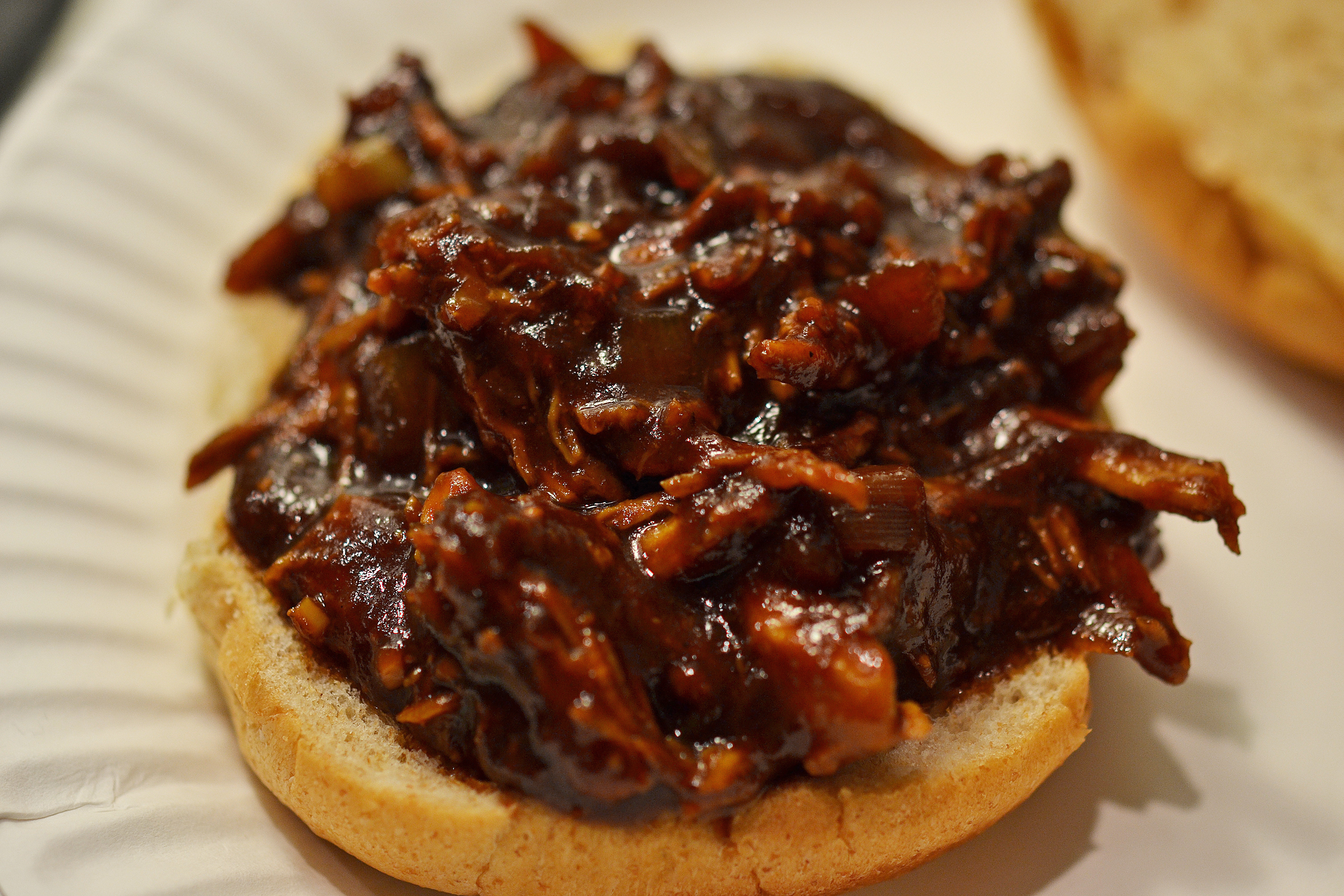
This sauce is amazing! I was somewhat wary of the orange, but Joy’s insistence (at Joy the Baker) had me convinced that this was a must-try sauce. Oh.My.God was she right! A beautiful union of citrus and spice, with just the right amount of sweetness, has easily made this a favorite in my book. You can serve it with any recipe that calls for barbecue sauce. I decided to shred chicken (what I had) and serve it on hamburger buns – even the sight of these wonderful sandwiches brought back warm memories of backyard, summer picnics back in the South. Click HERE to see how make these amazing sandwiches!
In addition to  the sandwiches, I thought a side salad would add a nice touch (as well as a healthy alternative). Broccoli salad is a classic in Southern dish, but its major flavor components are mayonnaise and bacon. Now I have no objection to bacon (as my next post will demonstrate), but the thought of a salad relying wholly on mayonnaise wasn’t the most appetizing affect. So I used a lighter version combined with the goddess of healthy cooking: Greek yogurt. With grapes, almonds and raisins, this Lighter Broccoli Salad was the perfect complement to a Barbecue dinner – click HERE to lighten up this Southern classic.
For pairing this meal, I wanted to showcase a composer whose nostalgia for home is equally as prominent in his music – that led me Béla Bartók. A Hungarian-born composer and pianist, his music is well-known for its incorporation of traditional folk melodies. He traveled all across Central Europe to track down folk musicians, collecting numerous songs through field recordings and/or transcriptions. His thorough analyses and collections of folk music helped institute the field of ethnomusicology. It wasn’t until World War II that Bartok left his beloved country and came to the U.S – though he never truly became acclimated to the culture (much like I will never become accustomed the grueling Northeastern winters), he managed to compose several masterpieces while in the States. The Concerto for Orchestra is one that is well-known and loved, but I was too extravagant for this meal, so I chose his Sonata for Solo Violin – the extent Hungarian influences make it the perfect pairing for a dinner that feels like home. Though I’ve paired the entire piece, I thought the nostalgic taste of the Melodia movement was appropriate to include – enjoy!

http://www.youtube.com/watch?v=5UKOKN8VL0w

Sources Cited:
“Béla Bartók,” Wikipedia.com

A Refreshing Trip

I spent this past weekend visiting with my mom in Philadelphia – she just moved there from Atlanta, and is still getting acclimated to a whole new city. We did all of the tourist-y things, from Reading Terminal Market (a foodie’s paradise) to Independence Hall. Having never spent much time in Philadelphia, I can officially say I’m enamored with that city – it’s similar to Boston (both epicenters of American history/tons of cultural opportunities), and has a great energy. Before leaving for the airport, we had a quick, healthy lunch of Curried Chicken Salad.
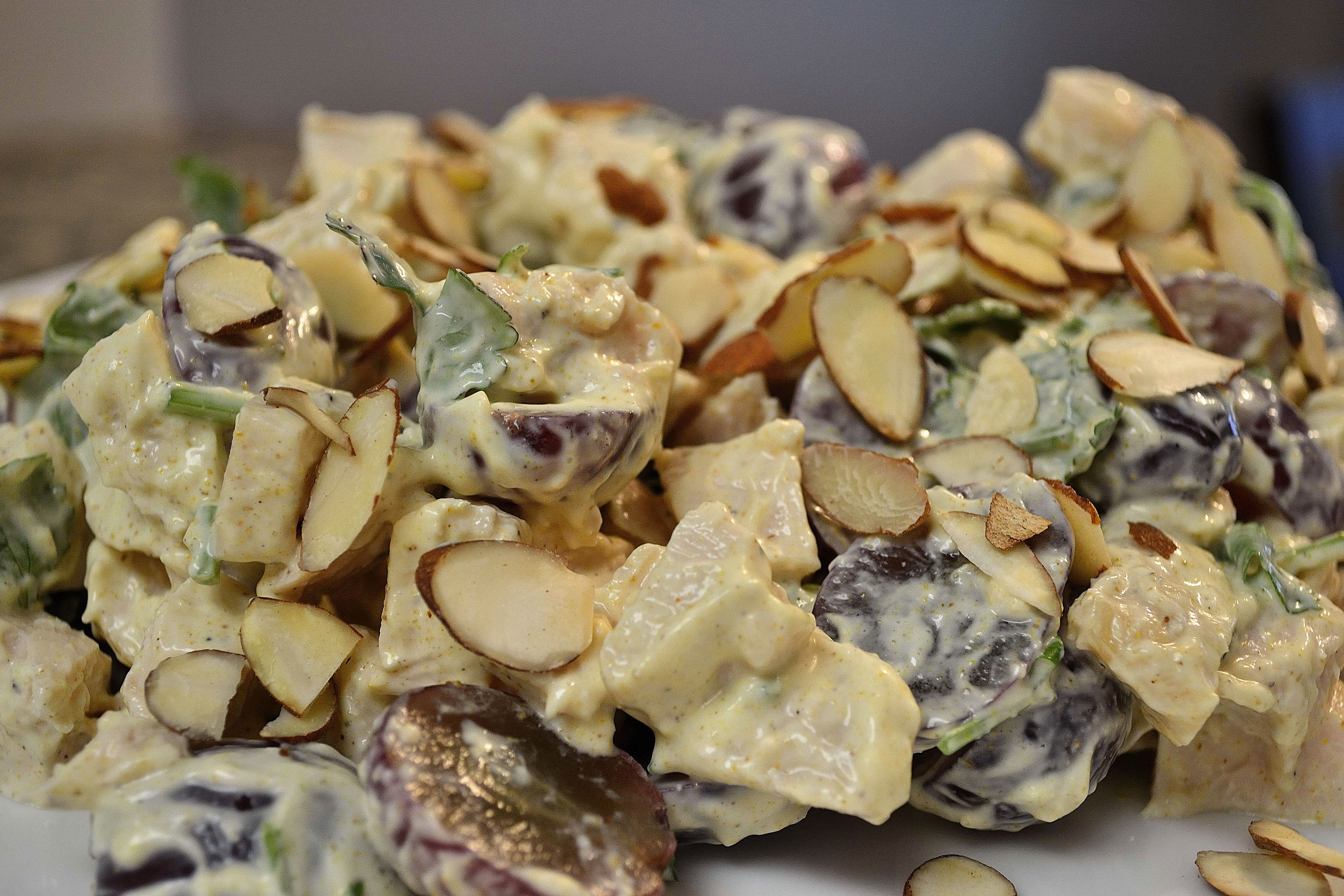
Rather than being the bland, mayonnaise-laden salad that you encountered at every family picnic, this salad has way more to offer with half the guilt. The recipe is courtesy of Food Network’s health guru, Ellie Krieger. With degrees in nutrition and public health, she creates dishes that are both flavorful and wholesome. For this salad, she replaces  mayonnaise with Greek yogurt.
She adds grapes for a touch of sweetness and color, cilantro to liven it up, and almonds for the added texture. That’s it! After one bite, my mom was hooked. It can be served atop a bed of greens, in a sandwich, or on crackers. So if you’ve got a rough week ahead, whip up a batch of this to give you a boost – click HERE to see how.
For the musical pairing, I wanted to choose a composer my mother truly adores – Mozart. His style beautifully complements the lightness of this dish. As there were only four major components in this salad (aside from the dressing), I thought a quartet would be suitable for this. So I chose his String Quartet No.4 in C major KV 157. This was one of the six quartets Mozart composed while in Milan (called the Milanese Quartets) – he was only sixteen at the time. The recording I’ve included is by the Jerusalem String Quartet. Thanks for a wonderful weekend in Philly, Mom – enjoy!

http://www.youtube.com/watch?v=FKzc4LMe8oU&feature=related

Sources Cited:
“Milanese Quartets (Mozart),” Wikipedia.com

Food for the “Starving Artist”

Perhaps I’m old-fashioned, but I prefer to be surrounded by lots of people when serving good food. What’s the point of creating a masterpiece if it can’t be enjoyed by others? This need for expression is a quality I can blame on my musical training 🙂 Yet sometimes a group can become much bigger than anticipated, and what was supposed to be 5 people suddenly turns into 10. It’s times like this when I seek recipes that give the most bang for the buck, and the May 2011 issue of Cooking Light had just the answer: Maple-Mustard Chicken Thighs.
I can almost guarantee that 90% of the ingredients for this marinade are currently sitting in your pantry (I’m not counting those who only eat microwaveable meals, naturally). This is a fantastic sauce, with the perfect balance of sweet and spicy. I’m also a firm believer in chicken thighs as they are less costly and more tender than chicken breasts, so this meal was bound to please – click HERE to learn more about this budget-friendly and amazingly delicious dish! I served these with a side of Leek and Potato Soup that was quite flavorful (and vegan!) – click HERE to see the recipe for this dish. 
I couldn’t help but pair this meal with (for the second time in a row) a piece by Mozart. The concept of the “starving artist” is famously affiliated with Mozart, and his works are arguably staples of the classical repertoire (much like the ingredients of this dish are “pantry” staples themselves). When discussing Mozart’s hardships, his Requiem is more often than not central to the conversation. This meal was very good, but far too modest to pair with such an exalted work. That led me to the gorgeous motet Ave verum corpus in D major, K. 618 (which many believe to be a precursor to the Requiem). Under 50 measures in length, it is orchestrated for choir, string orchestra and organ. The beauty of this piece is how it attains depth through tranquility, and can reach right into the soul. I’ve included a recording featuring the choir and orchestra of Bayerischer Rundfunk(Bavarian Broadcasting) with Leonard Bernstein conducting – enjoy!

http://www.youtube.com/watch?v=6KUDs8KJc_c

Sources Cited:
“Ave verum corpus (Mozart),” Wikipedia.com

Achieving Quality through Quantity

As I mentioned in my last post, I am attempting to use my cookbooks on a more regular basis. With the collection I have, I should be able to scrounge up a recipe or two per occasion. My dad’s visit to Boston this past weekend prompted such an event, and the neighbors were (as usual) on the guest list as well. You’ve heard me worship Ina Garten and her inspiring creations, so this next fabulous recipe (from her book Barefoot in Paris) should come as no surprise: Chicken with Forty Cloves of Garlic.Putting aside the fact that this is an Ina Garten recipe, I have always wanted to give this specific dish a try. I love garlic, and the thought of putting FORTY into one dish was too intriguing an offer to resist. A traditional French “comfort food,” this dish climbed its way up the culinary ranks due to its rich, complex flavor. There are many ways to make this dish, though the best recipes agree on the basic following: a good white wine, bone-in chicken parts with skin, and (of course) 40 entire cloves of garlic.
Though Julia Childs was a catalyst behind the American popularity of this dish, I was drawn to Ina’s. It’s a little bit more complicated than the original, but had multiple flavor notes I found intriguing (including the thyme, my favorite herb, and touch of Cognac). I omitted the heavy cream, and it was still utterly rich – click HERE to learn how to make this flavorful entree today! I also made a delicious side of Roasted Butternut Squash with Kale as a healthy afterthought – find that recipe HERE.
For the pairing, I wanted a piece that explored the layers of taste this meal achieved. It was the suggestion of Albert Oppenheimer that made for the perfect pairing: Spem in alium, a 16th-century motet by English composer Thomas Tallis with FORTY vocal lines! The work is divided into eight choirs, each with five parts, and gradually unfolds from a single voice into a magnificent assemblage of all forty parts. In addition to the literal connection of forty parts with forty cloves, the name of the motet is also complementary: while the title is Latin for “Hope in any other,” the Latin term for garlic just happens to be “allium” (see why this piece is a perfect match?). This recording is by the Taverner consort and choir – enjoy!

http://www.youtube.com/watch?v=1c6UYHbNYuA

Sources Cited:
“Spem in alium,” Wikipedia.com

A Colorful Plate with a Fiery Bite

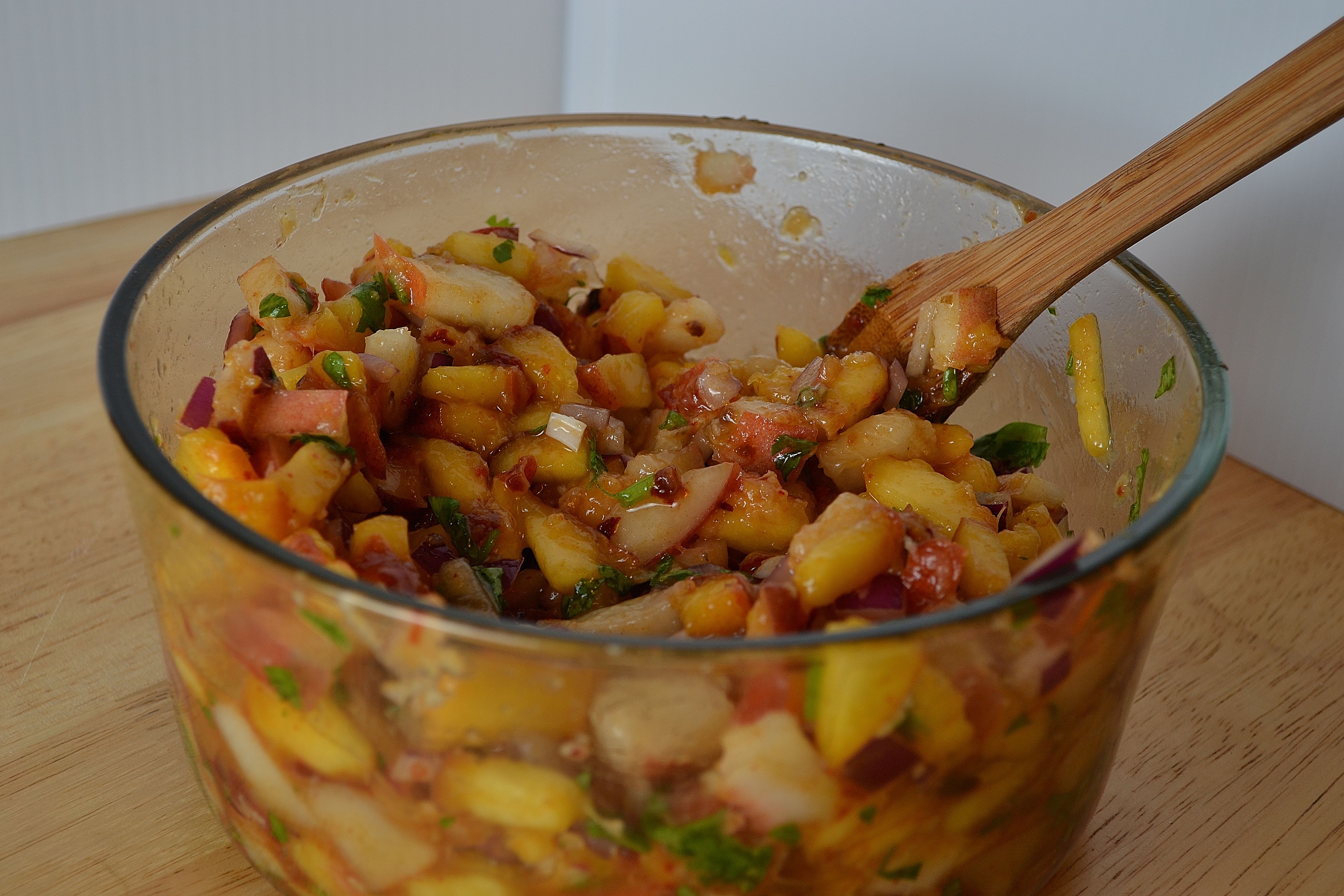
As some of you may know, I am a MAJOR fan of spicy food! I’m that crazy one who stacks a spoon wasabi onto each piece of sushi, and uses crushed red pepper flakes in nearly everything! My new favorite spice: chipotles en adobo. I regularly have a can of these stocked in my pantry or fridge. When I invited several friends over this past week for dinner, I found the perfect way to showcase these smoky favorites of mine: Ancho Chicken Thighs with Chipotle Peach Salsa. (Note: this photo was taken with my new lighting set! SO happy to not have to worry about taking late-night photos anymore!!!)
Being from Georgia, you can see why I LOVE this salsa! But really, this is a fantastic topping for any grilled food. It’s the perfect balance of sweet with heat. I used a combination of white and yellow peaches (to add color). The chipotle peppers pair perfectly with the fruit, and a touch of ginger gives it the finishing touch! Coating the chicken in chili powder was optional, but it made for one fantastic meal! Be sure to have plenty of chips on hand for the leftover salsa – it’s truly addictive, and you’ll be licking the bowl clean (not that we did…ahem). Click HERE to learn how to make this fun, spicy entrée!
I wanted my musical pairing to the reflect the firey, colorful aspects of this dish. That led me to one of my favorites YouTube recordings: Danzón No.2, by Arturo Márquez. The personalities of this work, as well as the overall spirit pair beautifully with the fresh, bright flavors of this dish. The particular recording I am referring to is by the world-renowned Venezuela Youth Orchestra. While this work is a definite showstopper, it’s this ensemble that sends this piece over the top. I hope you enjoy!

http://www.youtube.com/watch?v=3vwZAkfLKK8

The Heartfelt Comforts of Home

While I enjoy the beauty of gourmet cooking, there are times when all you want is the simple comfort of chicken soup. Such was the case this entire past week while I’ve been healing from surgery (hence my absence from the blogging world). My stepmom was a huge support, helping me get through the toughest stages of post-operative recovery (nearly 5 days). Her chicken broth was a lifesaver (as were Triscuits, but that’s beside the point). There are a number of ways to make stocks, but this Homemade Chicken Broth was the most delicious comfort I could ask for.
This broth is the perfect cure for days when the sun doesn’t seem quite as bright. All that’s needed is a whole chicken breast (skin-on and bone-in), a simple mirepoix (or combination of minced vegetables), and water – that’s it! It’s the perfect base for soups, sauces, casseroles, etc. In my lousy state, I enjoyed this broth as is with some crackers and vegetables on the side. Click HERE to see my stepmom’s perfect remedy for sick days.
To commemorate the simplicity of this broth, I wanted to choose a musical piece that evoked similar feelings of nostalgia. When I was younger and had trouble falling asleep, my parents would bring me a small wind-up toy with a melody to gently lull me to sleep: Beethoven’s “Für Elise.” One of Beethoven’s most famous works, the actual title of the piece is Bagatelle No. 25 in A minor for solo piano.* This work has been realized through countless transcriptions and has influenced a number of pieces, much like the varieties and styles this simple stock can assume. Given the work’s fame, I was only able to find a generic recording on YouTube (with no artist listed). While I imagine most everyone will recognize the theme, I’ve included it nonetheless – enjoy!

http://www.youtube.com/watch?v=_mVW8tgGY_w&feature=related

* “Für Elise.” Wikipedia.com